


Quality of hire – TA’s problematic metric
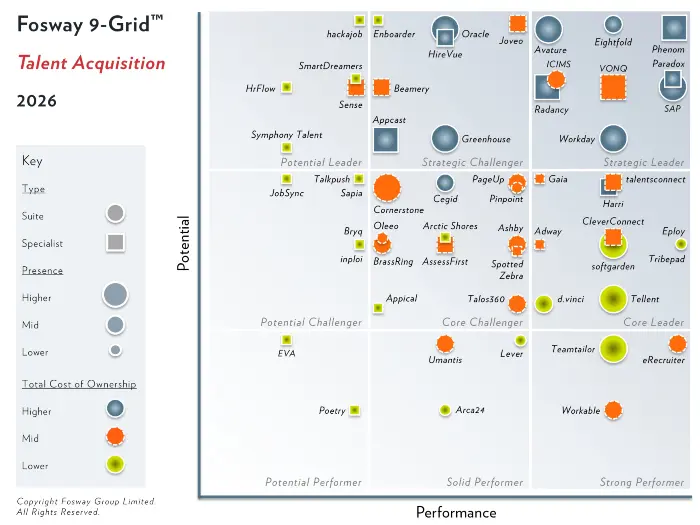
Published in May 2026, the Fosway 9-Grid™ for Talent Acquisition looks at the recruiting technology market for EMEA’s TA leaders – here, Fosway analysts make a stark assessment about quality of hire.
Most hiring now faces a clearer value test, with fewer roles moving through approval automatically. Business leaders still want new hires to perform, stay and ramp quickly, but that is no longer enough where work is changing so fast. For desk-based roles in particular, hiring quality increasingly needs to include digital confidence, adaptability and the ability to keep learning as AI changes workflows and the skills needed to do an evolving job. The big problem is that most quality-of-hire models still look backwards, while the business increasingly needs stronger indicators of future performance and adaptability.
TA can measure speed and cost of hire as well as conversion because they all sit within the recruiting process. But future hiring quality depends on post-hire metrics such as time to competence, real-world performance, skills growth and longer-term retention. Most TA functions are not focused on, or ready to prove, this broader view of quality of hire, and most TA solutions still provide only cursory support. This is not just a data problem. In EMEA especially, privacy requirements, works councils agreements, fragmented systems and cultural differences in performance make quality of hire even harder to define and govern, let alone compare. Without a holistic, common model, quality of hire will remain a reporting aspiration rather than a decision standard.
TA buying re-bundles around stronger HCM suites
HCM providers are strengthening TA capability while companies face pressure to consolidate platforms and simplify their HR and talent ecosystem. TA solution providers face a higher proof threshold: buyers need a clearer reason to add capability beyond the HCM suite. In large enterprises, HCM suites generally form the HR backbone while additional TA solutions, including dedicated TA suites and specialists, support complex hiring requirements. Stronger TA capability in HCM suites makes additional TA solutions less necessary, especially when recruiting workflows are relatively standard. Dedicated TA suites and specialists still win where their differentiated capability is outcome-critical, but even then, they need to prove a significant advantage.
AI is now one of the main ways providers are trying to prove that. HCM suite pressure is strongest in mid-enterprise, where IT, HR and TA resources are more limited, and implementation effort and integration costs are very visible. Smaller enterprise and lower mid-market buyers still compare ‘good enough’ HR suite recruiting capability with dedicated TA platforms built for speed and ease of use. For buyers, the real question is whether additional TA capability materially improves hiring outcomes by managing complexity better, or solving problems the HCM suite does not address.
Application friction is back, but it needs to earn its place
For years, talent scarcity pushed TA teams to remove friction from the application process. That logic has now changed as weaker labour-market conditions and AI-amplified application volume create fuller funnels. But higher application volume does not mean stronger candidate supply. It often just makes it harder to find the right candidates fast enough. Many vendors position better AI matching and filtering as the answer, but the emerging corporate response is more early qualification through eligibility checks, suitability questions and earlier pre-screening. This is a rational response to increased candidate volume, but it risks recreating the candidate-hostile application process that employers spent years trying to dismantle.
Friction needs to earn its place – it should be transparent, proportionate and role-relevant, improving fit and decision quality rather than simply reducing applicant numbers or weakening trust before a real conversation has happened. AI may help manage volume in high-application roles, but organisations still need to prove that it improves decision quality and candidate fairness, rather than just automating rejection earlier.
This is an excerpt from the Fosway 9-Grid™ for Talent Acquisition. Get the full insight and discover all the latest market and solution trends by reading the whole report here.
What should you do next?
- Add your voice to our Talent Acquisition Realities research – it’s the essential benchmarking resource for EMEA’s recruiting and resourcing leaders.
- Build your evidence-based AI strategy with Europe’s most experienced HR industry analysts. Sign up here.
Other recommended reading
- The 2026 update is imminent – before it arrives, read the 2025 AI Market Assessment for Talent Acquisition. How will the landscape have changed?
- The 2025 Fosway 9-GridTM for Cloud HR – full report. Released in September 2025, it’s the latest market and solution trends in Cloud HCM.
For corporates looking for deeper insight on this and other similar topics, please consider joining our Fosway research network to get access to corporate roundtables, private 1-1 analyst time, benchmark reports and other analyst services or project support. Click here to find out more.
Please also visit the Fosway Knowledge Centre.
Check out other relevant Fosway research and insights, including filters for segment category, key topics, type of content and vendor-specific information.
 English (UK)
  Deutsch
  Français