


AI is blurring learning market boundaries
Published in March 2026, the Fosway 9-Grid™ for Digital Learning looks at the learning content market for EMEA’s business leaders – here, Fosway analysts look at how AI is blurring learning market boundaries between digital learning and learning systems.
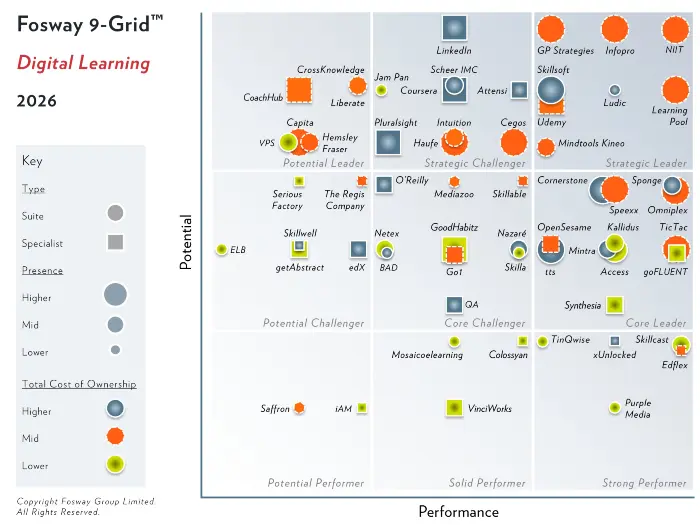
The universal availability of powerful AI technology is now enabling vendors to seek growth beyond their traditional boundaries, and traditional categories are becoming less useful as a guide to vendor capability. As the 2026 9-GridTM for Learning Systems report highlighted , learning platform providers are encroaching further into the Digital Learning segment, adding more sophisticated content curation tools, authoring capability and content libraries.
The acquisition of authoring platforms is the latest signal of this trend, and AI capability lowers the barriers to developing these capabilities further. Digital learning specialists in immersive and simulation solutions are adding more powerful authoring and customisation features to their platforms too, powered by AI. Traditional content providers are adding simulations and adaptive features to their own products, also accelerated by AI. Many customers are leveraging AI tools too for increased internal design and delivery using their own instructional designers or subject matter experts. To further muddy the waters, synthetic media vendors see design and authoring as an opportunity to extend their offering, bringing native AI tools and speed of execution to the content creation segment.
The need for value persists but buying is yet to shift
Last year we noted that the need to demonstrate value is now a mainstream customer expectation. It has solidified further this year. Vendors are working hard to provide more meaningful analytics than historic consumption and test scores. Learner behaviour and skills proficiency data are becoming more central to demonstrating the effectiveness of learning investment. AI plays a crucial role here too, gathering data on individual performance from personal experiences at a level of detail that was previously impossible. Handling large volumes of data quickly brings new utility to dashboards and reporting. By reducing much of the heavy lifting in assessment design and analysis, AI can make programme evaluation richer. Expectations of demonstrating real impact and value are rising as a result.
However, we are yet to see meaningful progress towards value-based pricing and the market remains dominated by seat-based or site-wide licensing, and content buying is still structured around volume. Vendors are conscious of this contradiction, but a resolution is not yet apparent. Customer budgets are allocated on fixed inputs, limiting their scope to buy in other ways, no matter how much the conversation around value continues. Any disruption to established purchasing behaviour is perhaps most likely to come from outside the industry.
The skills challenge is as important as ever
Our Digital Learning Realities Research in 2025 confirmed upskilling and reskilling as the top priority for L&D for the second year running, narrowly beating AI, with 56% of respondents. This long-standing trend is at the heart of strategy and roadmap investment across the industry. The challenge of identifying skills, mapping skills to business priorities, developing skills and monitoring proficiency is central for leaders under pressure.
AI is enabling a level of relevance for skills development that was previously hard to affordably achieve. Skills practice and feedback is now possible for a range of interpersonal skills with AI conversation tools, simulations and role plays. Granular behaviour data from this activity makes measurement of progress more accurate and scalable, and provides insight into skills validation for in-demand areas. Automation of assessments allows more efficient benchmarking and personalisation. Certification of hard to hire skills, especially in cutting-edge technology disciplines, is becoming a must have. The pace of AI is generating a seemingly endless demand for skills development in the latest breakthroughs.
This is an excerpt from the 2026 Fosway 9-Grid™ for Digital Learning. Get the full insight and discover all the latest market and solution trends by reading the whole report here.
What should you do next?
- You can read the full 9-Grid™ for Digital Learning report here – learning content market insight that no other analyst can match.
- The Digital Learning AI Insights 2026 Market Assessment provides buyers with a clear analysis of the AI innovation in the Digital Learning market – read our latest critical research here.
- Digital Learning Realities 2026 – share your experience of digital learning, get first look access to the results, and benchmark your progress.
Other recommended reading
- Build your AI strategy with evidence, not guesswork. All our published research so far is here >> Fosway AI Strategic Research Programme
For corporates looking for deeper insight on this and other similar topics, please consider joining our Fosway research network to get access to corporate roundtables, private 1-1 analyst time, benchmark reports and other analyst services or project support. Click here to find out more.
Please also visit the Fosway Knowledge Centre to check out other relevant Fosway research and insights, including filters for segment category, key topics, type of content and vendor-specific information.
 English (UK)
  Deutsch
  Français