

E-learning: The Volume Vs. Value Equation
This is the second article in the ‘Recipes for E-learning Success’ series. In it, Fosway analysts implore L&D professionals in the early 2000s not to focus on the size of their burgeoning e-catalogues, but to focus on the quality. Useful insight and advice, particularly for large enterprises.
Janvier 2001
In the first article in this series, we analysed the factors that go into making e-learning successful in organisations. In hard terms, the percentage of training and development activity that currently is delivered or supported using technology is still very small. Whilst certain sectors such as IT training have moved more quickly to adopt broader use of technology-supported learning, for others it hasn’t even appeared on the radar.
The real issue is not about the magnitude of the shift required to achieve this adoption of e-learning. Our concern is more about the nature of the shift – ensuring that the focus is about value rather than just volume. There is a real danger that in the e-gold rush to put content online and make it interactive, we miss the point and focus on the size of the e-catalogue rather than the value of the learning it delivers. With much of the early justification for investment in e-learning being based on reducing the cost of training delivery, it is easy to concentrate on simple equations of volume training economics and cheap online courses. The singular focus placed on cost reduction is probably one of the largest challenges we face when talking to companies about e-learning.
Most e-learning activity is currently in areas of generic skills and knowledge acquisition around areas such as IT, or health and safety. We call this first stage e-thinking – a focus on cost and volume rather than value. It is concerned with content delivery rather than learning quality.
The driver behind this first stage thinking is simple, it is economics. If you are a corporation with thousands of employees who need training in generic skills and knowledge, sending them away on courses is expensive. It is expensive for them to be there (opportunity cost), expensive for them to get there (travel and subsistence) and it’s expensive for them to be trained (training cost). If you can put them through some online courses that are available off-the-shelf for a fraction of the cost, financially it makes a lot of sense.
The economics river also flows the other way too. If you are a training provider investing in developing e-content, you need to develop course titles that sell in volume. Anyone with experience of technology-based training content production will understand why. Creating high quality interactive web content is expensive. If the development cost is high and the target price needs to be low because of the inherent demand to reduce the cost per head, then the number of heads has to be high. Titles need to sell in volume.
Both the provider and the corporation therefore agree – create high quality low cost generic content and focus on volume.
The trouble is that the economics of cost isn’t necessarily the economics of value. Whilst cost economics may work better with volume, value economics don’t. The volume may be greater in generic content areas, but the higher value is achieved with more specific or unique subject matter. This can be simply illustrated in the following diagram.
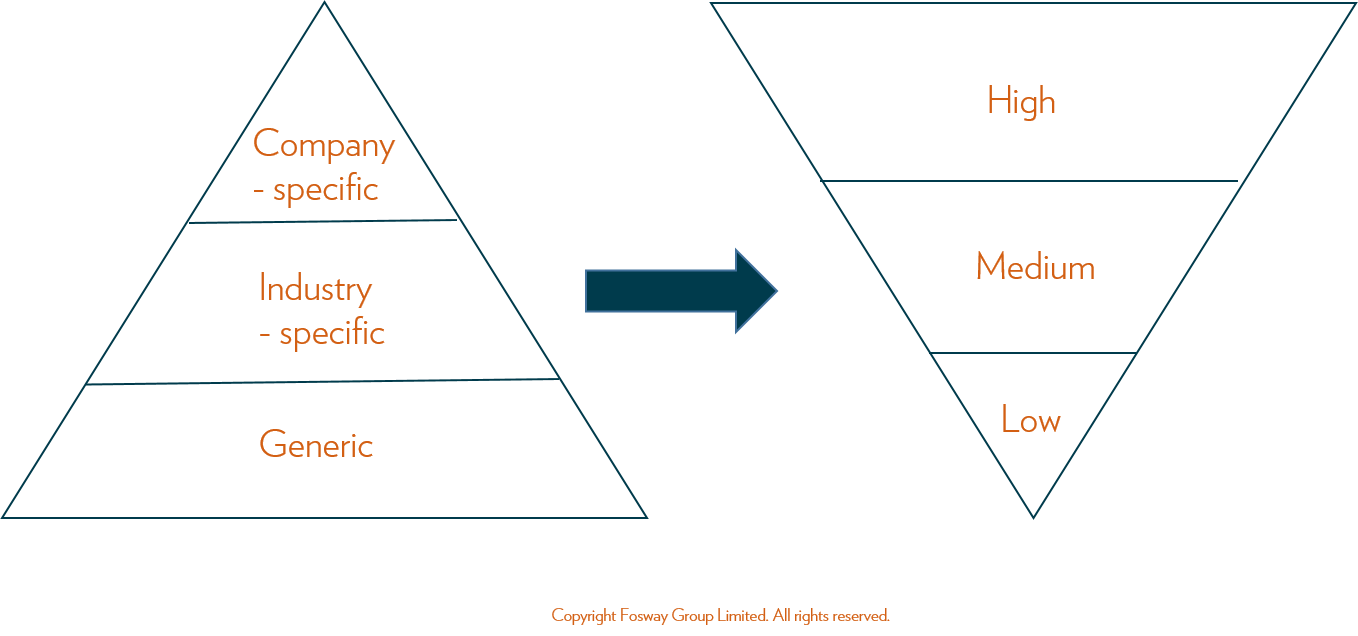
The left triangle shows the layers of the organisational skills development cake. At the lower levels where skills are generic, the volume is high. Look at IT applications training. This marketplace is very competitive with lots of suppliers and lots of alternatives – classroom, books, CDs, videos and now internet-delivered courses. But while volume may be high, for generic areas, value is not. Knowledge is often quite superficial, and in organisational performance terms aggregate value is low.
As we move up the layers, the subject matter becomes less generic and more focused: firstly around the specific industry or business within which the company operates, and then ultimately to aspects which are unique to the company. It concerns people, products and processes. Although the volume of activity decreases, the value delivered increases. There is evidence to indicate that this value increases exponentially rather than linearly. As we become more focused and company-specific, aggregated value gets larger.
So what does this all mean? From a corporate training and development point of view, the obvious focus of e-learning activity on high volume generic skills is wrong. That is not to say it is not worth doing, just that there are other things that are more valuable. We should be looking at how we can use e-learning to support and re-engineer the delivery of core development programmes and company-specific subject matter.
Here is where the true benefits of e-learning come into play, outside reduced cost of delivery. The ability to:
• Reduce time to learner, making new knowledge accessible across the company almost instantaneously
• Reach people regardless of their location
• Integrate learning and development activity right into the workplace
• Manage learning and development assignments based around real business problems
• On the job rather than theoretical case studies in a classroom
• Provide online mentoring support and coaching support direct to the learner’s desktop
With tools like live virtual classrooms running across the corporate intranet or accessible remotely through dial-up connections, it is possible to rapidly develop and deliver company specific training sessions and discussions across the business. Once the technology infrastructure is in place, these sessions can be produced within days rather than weeks or months. Time to market is reduced and relevancy of the material is increased. A subject expert can develop material using standard tools like Word and PowerPoint rather than specialist multimedia development tools. Sessions can then be scheduled and delivered live to groups of people in any location. It means that there are cost savings based on reduced travel and subsistence, even if the content is not self-paced and requires a facilitator. These sessions can also be recorded and made available to others who were unable to make the live events, increasing the reach and consistency of delivery. Importantly what we are recording is not just one-way traffic from the presenter. We are recording the interaction from the learners and the use of the supporting tools. The value is higher.
This approach is very powerful and directly applicable to almost all development programmes within business today. Time to market can be reduced dramatically, and the value of the learning is very high, as it is totally customised and specific. Here we are using e-learning as a mechanism to accelerate and enable communication, collaboration and facilitation of learning, not just as a mechanism to push content.
And that is where e-life becomes really interesting!
Résumé
La réussite de l'e-learning repose sur trois domaines clés. Premièrement, une compréhension approfondie de toutes les composantes – desLearning Management Systems aux techniques de développement de contenu, de l'infrastructure informatique à la conception pédagogique et à la gestion du changement organisationnel. Ensuite, comme les programmes d'e-learning sont rarement peu coûteux, il est essentiel d'obtenir un retour sur investissement élevé, il est donc crucial de faire appel aux ressources les plus expérimentées pour réussir. La valeur de ceux qui l'ont déjà fait ne doit pas être sous-estimée. Enfin, il est essentiel de coordonner et de gérer ces composantes, fonctions et ressources. L'e-learning franchit de nombreuses frontières et doit être considéré comme une démarche stratégique, gérée comme un programme véritablement interfonctionnel.
We hope that the articles in the ‘Recipes For E-learning Success’ series help you to understand some of the current issues surrounding this topic and have stimulated you to review your ideas on e-learning. Fosway is continually researching and developing e-learning best practice, and is focused on sharing its knowledge and experience with its customers and e-learning practitioners.
Lecture recommandée par Fosway
Les autres articles de cette série sont les suivants :
• Recettes pour la réussite de l'e-learning
• Blended or Integrated E-learning
• Dynamiques de conception pour l'e-learning
• Construire des communautés d'apprentissage
• Synchrone ou asynchrone
• Normes de l'e-learning
Accélérer et réduire les risques
Pour discuter de nos recherches sur les systèmes d'apprentissage et de talents, ou pour explorer ce que cela pourrait signifier spécifiquement pour votre organisation, veuillez nous contacter directement.
Nous utiliserons notre expertise indépendante pour vous fournir les conseils dont vous avez besoin afin d'accélérer et de réduire les risques de vos décisions. Nous avons à notre disposition une richesse d'expériences, d'outils, de recherches et de profils.
Nous n'avons aucun produit à vendre et aucun intérêt personnel à influencer vos résultats. Nous nous concentrons sur des conseils pragmatiques et indépendants.
Exactitude des informations et garanties
L'analyse et les recommandations faites dans ce document sont basées sur les informations actuellement disponibles pour Fosway et provenant de sources jugées fiables.
Fosway décline toute garantie quant à l'exactitude, l'exhaustivité ou l'adéquation de ces informations. Fosway ne pourra être tenu responsable des erreurs, omissions ou inadéquations des informations contenues dans ce document ou de leurs interprétations.
Les opinions exprimées dans ce document sont susceptibles de changer sans préavis. Tout le contenu est la propriété de Fosway limited, sauf indication contraire. Tous droits réservés.
A propos de Fosway Group
Chez Fosway Group, nous sommes convaincus que c'est en développant et en mobilisant leurs collaborateurs que les grandes entreprises internationales parviennent à être performantes et à réussir. Tout comme le parcours de chaque collaborateur est unique, la stratégie RH de chaque entreprise l'est également.
Les services d'analyse et de conseil de Fosway Group vous fournissent les informations dont votre organisation a besoin pour obtenir des résultats et éliminer les risques. Nous savons que tous les aspects des ressources humaines et de la gestion des talents de nouvelle génération sont plus étroitement liés que jamais. En collaborant avec nous, vous accélérez votre prise de décision et prenez de meilleures décisions.
Nous sommes le premier analyste RH indépendant d'Europe, et tout comme la voie romaine dont nous tirons notre nom, vous constaterez que nous sommes d'une franchise hors du commun. Nous n'avons aucun intérêt particulier dans vos choix technologiques ou en matière de conseil. Vous pouvez compter sur nous pour vous dire ce que vous devez savoir pour réussir.
Parmi nos clients, on peut citer : Alstom, Aviva, Boots UK, BP, BT, Centrica, Deutsche Bank, Faurecia, HSBC, International SOS, Lloyds Banking Group, Novartis, PwC, Rolls-Royce, Royal Bank of Scotland, Sanofi, Shell, Swiss Re, Telefonica, Thomson Reuters, Toyota Europe et Vodafone.
Contactez-nous
Contactez dès aujourd'hui notre équipe d'analystes pour nous faire part de vos besoins en matière de gestion des talents et bénéficiez de conseils avisés sur votre processus de recrutement et votre prise de décision stratégique. Contactez-nous en ligne, par téléphone au +44 (0)20 7917 1870 ou par e-mail info@fosway.com.
 Français
  English (UK)
  Deutsch