

Dynamique de conception pour l'apprentissage en ligne
Understanding the underlying dynamics of a specific learning requirement, and then being able to map into a viable learning delivery approach, is fundamental to any successful e-learning project. The fourth part of the ‘Recipes For E-learning Success’ series was written in 2001 but many of the design principles still apply.
Janvier 2001
There are many different types of learning requirement as well as a variety of subjects. These requirements vary significantly, and may be outside what historically has been known as ‘training and development’. Some diverse but very common examples could include:
• Internal company announcements following a corporate takeover, explaining the rationale and impact of the change
• Training an experienced field-sales organisation in new products or new legislation
• Developing senior management programmes to enhance business performance and stimulate business creativity
E-learning can have a role in fulfilling any or all of these requirements. Understanding the underlying dynamics of a specific learning requirement, and then being able to map into a viable learning delivery approach, is fundamental to any successful e-learning project.
Designing example solutions
The logistical demands of the company takeover (lots of people, very short space of time), probably mean that an overview document/presentation and Frequently Asked Questions (FAQ) document need to be distributed to everyone quickly. But this solution never answers all the questions or gets feedback from the organisation back to management. More importantly, it doesn’t allow the employees to feel part of the change process. Implementing a managed discussion forum to support the information delivery and to answer key questions would increase the effectiveness of communication considerably.
Training a field-sales organisation is a constant need, and has a very high opportunity cost if the sales staff need to attend classroom training sessions on a regular basis. Electronically pushing information out to an already-overloaded sales staff does not necessarily provide an effective learning approach.
In this scenario, creating an online (e-)learning community which the sales team can access from their laptops would provide a better environment to manage learning and improve sales effectiveness. New product or legislative training can then be delivered in a controlled way on an ongoing basis. However, given the nature of the training and the audience, it is critical that this education isn’t just information push. The sales team needs the chance to discuss and understand the implications of the new products: how do they compare to the existing range or that of the competition? This e-learning environment needs to be actively facilitated to manage discussions and gather feedback. It also needs subject experts to provide direct support and answer questions. It needs content too; everything from product specifications and presentations to industry analysis, external references and specific customer experiences. Some of these items are provided by the sales team themselves, giving them an extra sense of ownership. This integrated environment then becomes a highly effective learning and development solution for the sales force and an ongoing reference tool.
In the case of the senior management programme, there are likely to be key components which must be done face-to-face in a facilitated workshop environment, including peer discussion and review and input from external industry experts. The trouble is, to do this properly you probably need lots of time, typically 10 or more days, and that is just not feasible.
What if we restructure it as an integrated e-learning programme? The face-to-face time can be reduced significantly, maybe to a two-day initial session, followed by two months of facilitated online collaborative and coached development, and then a final two-day session. Included in the facilitated session may be a number of online synchronous presentations and question/answer sessions with leading gurus, who may not be able to travel to meet with the participants. Whilst there may be pre-defined materials, much of the content and structure will develop during the workshops and online collaboration sessions. Resources of all kinds, particularly documents and references to external resources are critical, but are probably added as the specific context develops. Neither the audience nor the subject lend themselves to fixed structures or ‘click next’ content. The online environment is discussion and action-centric not content-centric – it is a learning community rather than a course. Focus is on outcomes not structure.
All three of the above examples represent a very different approach and a very different e-learning experience. The design, the level of importance attached to core components of the learning structure, the nature of the content, participation and instruction/facilitation, are all specific to the context in which they are found. Applying the same approach to each of the above situations would be disastrous, resulting in very poor outcomes and low e-learning value.
E-learning Dynamics Matrix
At Fosway, we have developed models to enable us to better map the types of learning requirements based on our experience of many e-learning projects. Most importantly, these include approaches to understanding the learning dynamics underlying the specific requirement including structure, content, participation and instruction/facilitation. This information can then be constructed as an e-learning programme model and can be used to help us identify the appropriateness and role of associated technology support.
We represent this mapping process using an E-learning Dynamics Matrix. The version below is simplified for ease of discussion, with a restricted set of e-learning characteristics and learning models.
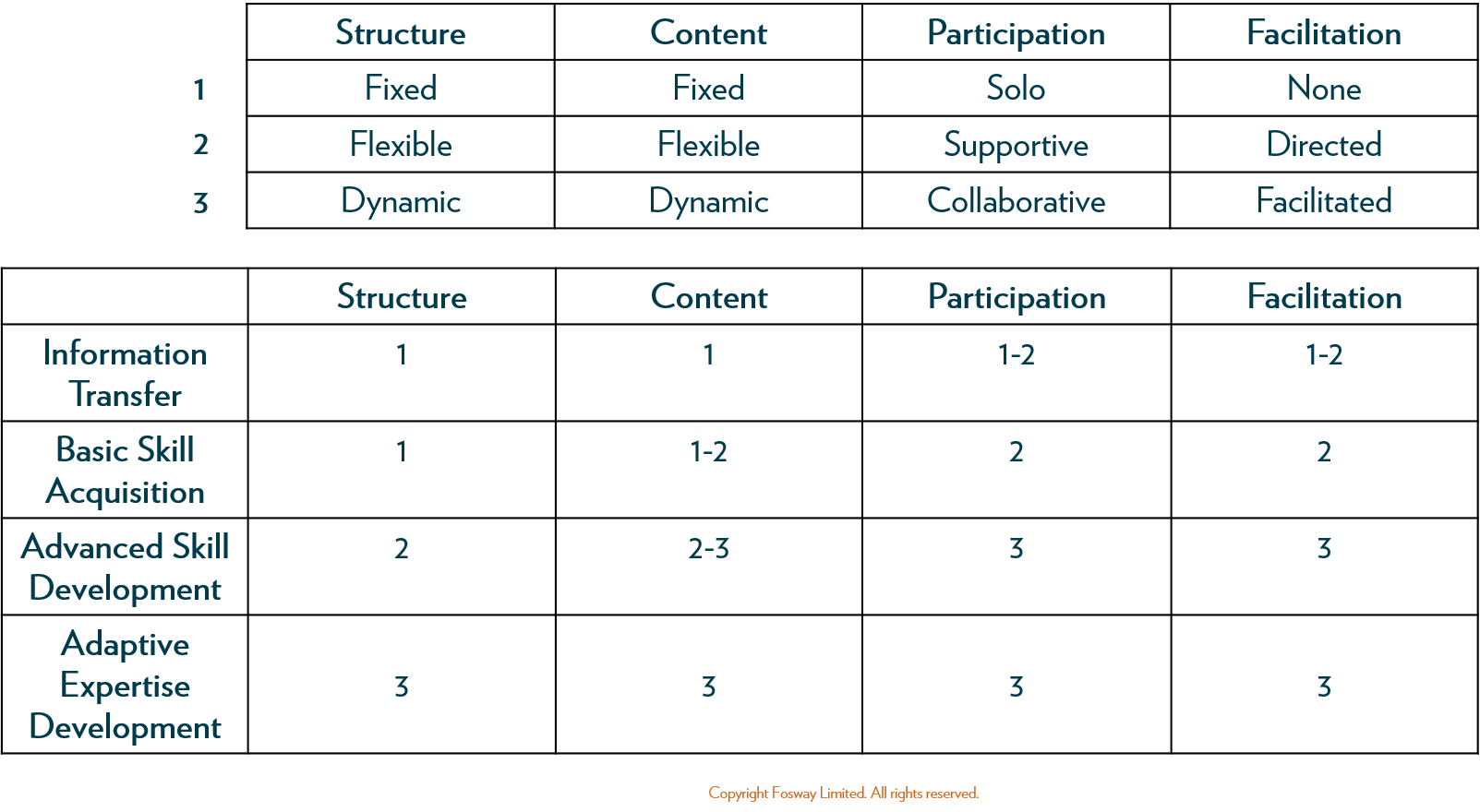
The matrix can be applied to defined learning requirements and gives us a clearer understanding of the relative role of the different components. It tells us whether fixed learning structures are appropriate, whether content needs to be flexible in form (multiple types), and the degree of collaboration or instruction needed.
Looking at where the three examples fit into the E-learning Dynamics Matrix:
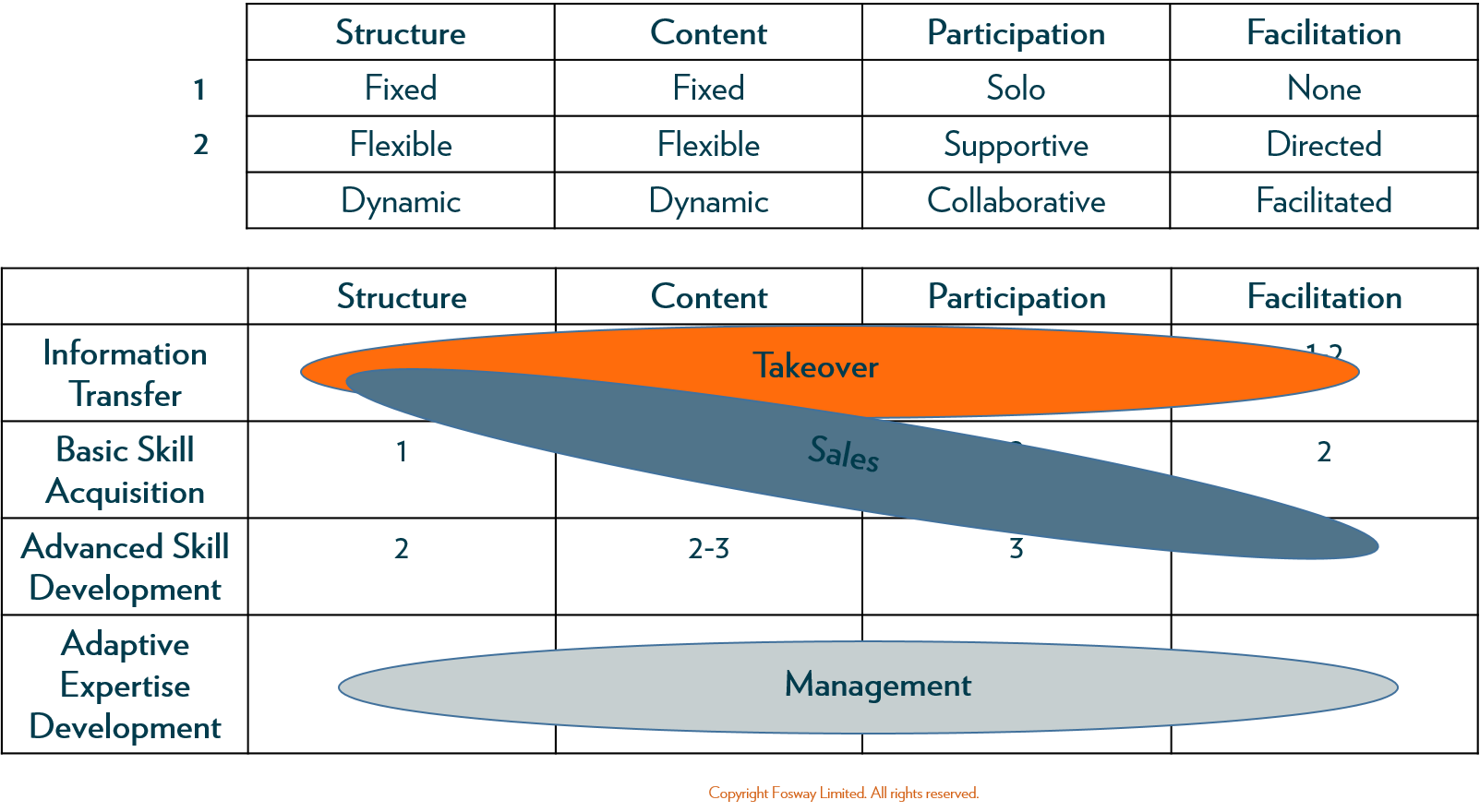
Applying the E-learning Dynamics Matrix to our three examples might look like the following:
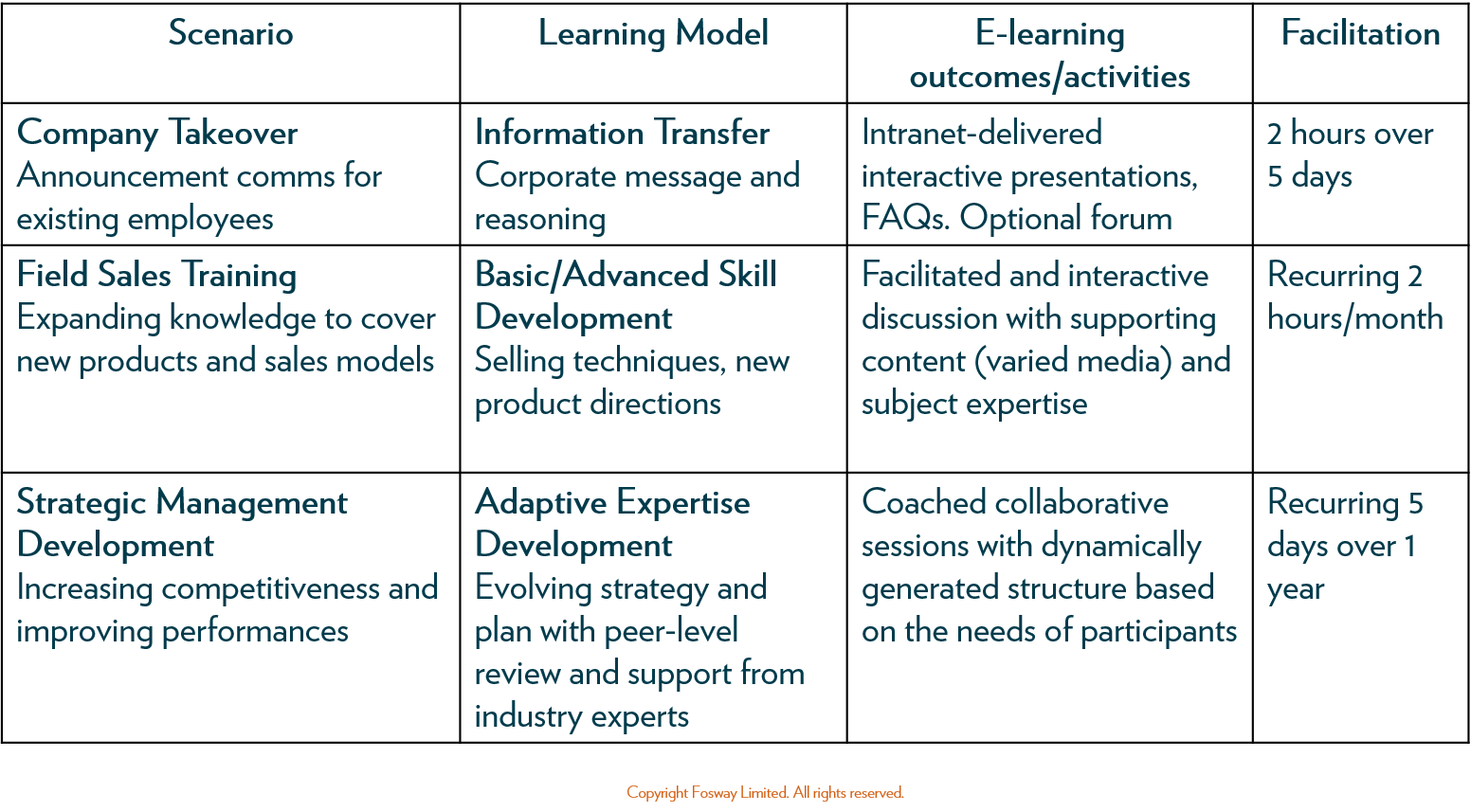
As you can see from the table, the application of the simplified E-learning Dynamics Matrix enables us to map from a Learning Model to an E-learning Outcome which outlines a learning approach and learning activities. This approach can then be mapped into an e-learning technical design, which defines the characteristics of the underlying technology and helps to determine the types of products we need.
Of course, this mapping process is not the whole answer. There are other important factors, including the specific subject matter itself and how that lends itself to online representation. Also we need to consider the needs of the students, delivery logistics, technology and infrastructure, longer-term strategy and so on.
But, by understanding the underlying nature of the learning requirement and the key dynamics of learning associated with it, we can at least start to map out a sensible way of delivering it, to ensure we are constructing an e-learning approach where we deliver real learning value.
Résumé
La réussite de l'e-learning repose sur trois domaines clés. Premièrement, une compréhension approfondie de toutes les composantes – desLearning Management Systems aux techniques de développement de contenu, de l'infrastructure informatique à la conception pédagogique et à la gestion du changement organisationnel. Ensuite, comme les programmes d'e-learning sont rarement peu coûteux, il est essentiel d'obtenir un retour sur investissement élevé, il est donc crucial de faire appel aux ressources les plus expérimentées pour réussir. La valeur de ceux qui l'ont déjà fait ne doit pas être sous-estimée. Enfin, il est essentiel de coordonner et de gérer ces composantes, fonctions et ressources. L'e-learning franchit de nombreuses frontières et doit être considéré comme une démarche stratégique, gérée comme un programme véritablement interfonctionnel.
Nous espérons que les articles de la série ‘ Recettes pour le succès de l'e-learning ’ vous aideront à comprendre certains des problèmes actuels entourant ce sujet et vous auront incités à revoir vos idées sur l'e-learning. Fosway recherche et développe continuellement les meilleures pratiques en matière d'e-learning, et s'efforce de partager ses connaissances et son expérience avec ses clients et les praticiens de l'e-learning.
Lecture recommandée par Fosway
Les autres articles de cette série sont les suivants :
• Recettes pour la réussite de l'e-learning
• L'équation Volume contre Valeur
• Formation en ligne mixte ou intégrée ?
• Construire des communautés d'apprentissage
• Synchrone ou asynchrone
• Normes de l'e-learning
Accélérer et réduire les risques
Pour discuter de nos recherches sur les systèmes d'apprentissage et de talents, ou pour explorer ce que cela pourrait signifier spécifiquement pour votre organisation, veuillez nous contacter directement.
Nous utiliserons notre expertise indépendante pour vous fournir les conseils dont vous avez besoin afin d'accélérer et de réduire les risques de vos décisions. Nous avons à notre disposition une richesse d'expériences, d'outils, de recherches et de profils.
Nous n'avons aucun produit à vendre et aucun intérêt personnel à influencer vos résultats. Nous nous concentrons sur des conseils pragmatiques et indépendants.
Exactitude des informations et garanties
L'analyse et les recommandations faites dans ce document sont basées sur les informations actuellement disponibles pour Fosway et provenant de sources jugées fiables.
Fosway décline toute garantie quant à l'exactitude, l'exhaustivité ou l'adéquation de ces informations. Fosway ne pourra être tenu responsable des erreurs, omissions ou inadéquations des informations contenues dans ce document ou de leurs interprétations.
Les opinions exprimées dans ce document sont susceptibles de changer sans préavis. Tout le contenu est la propriété de Fosway limited, sauf indication contraire. Tous droits réservés.
A propos de Fosway Group
Chez Fosway Group, nous sommes convaincus que c'est en développant et en mobilisant leurs collaborateurs que les grandes entreprises internationales parviennent à être performantes et à réussir. Tout comme le parcours de chaque collaborateur est unique, la stratégie RH de chaque entreprise l'est également.
Les services d'analyse et de conseil de Fosway Group vous fournissent les informations dont votre organisation a besoin pour obtenir des résultats et éliminer les risques. Nous savons que tous les aspects des ressources humaines et de la gestion des talents de nouvelle génération sont plus étroitement liés que jamais. En collaborant avec nous, vous accélérez votre prise de décision et prenez de meilleures décisions.
Nous sommes le premier analyste RH indépendant d'Europe, et tout comme la voie romaine dont nous tirons notre nom, vous constaterez que nous sommes d'une franchise hors du commun. Nous n'avons aucun intérêt particulier dans vos choix technologiques ou en matière de conseil. Vous pouvez compter sur nous pour vous dire ce que vous devez savoir pour réussir.
Parmi nos clients, on peut citer : Alstom, Aviva, Boots UK, BP, BT, Centrica, Deutsche Bank, Faurecia, HSBC, International SOS, Lloyds Banking Group, Novartis, PwC, Rolls-Royce, Royal Bank of Scotland, Sanofi, Shell, Swiss Re, Telefonica, Thomson Reuters, Toyota Europe et Vodafone.
Contactez-nous
Contactez dès aujourd'hui notre équipe d'analystes pour nous faire part de vos besoins en matière de gestion des talents et bénéficiez de conseils avisés sur votre processus de recrutement et votre prise de décision stratégique. Contactez-nous en ligne, par téléphone au +44 (0)20 7917 1870 ou par e-mail info@fosway.com.
 Français
  English (UK)
  Deutsch