

Design-Dynamiken für E-Learning
Understanding the underlying dynamics of a specific learning requirement, and then being able to map into a viable learning delivery approach, is fundamental to any successful e-learning project. The fourth part of the ‘Recipes For E-learning Success’ series was written in 2001 but many of the design principles still apply.
Januar 2001
There are many different types of learning requirement as well as a variety of subjects. These requirements vary significantly, and may be outside what historically has been known as ‘training and development’. Some diverse but very common examples could include:
• Internal company announcements following a corporate takeover, explaining the rationale and impact of the change
• Training an experienced field-sales organisation in new products or new legislation
• Developing senior management programmes to enhance business performance and stimulate business creativity
E-learning can have a role in fulfilling any or all of these requirements. Understanding the underlying dynamics of a specific learning requirement, and then being able to map into a viable learning delivery approach, is fundamental to any successful e-learning project.
Designing example solutions
The logistical demands of the company takeover (lots of people, very short space of time), probably mean that an overview document/presentation and Frequently Asked Questions (FAQ) document need to be distributed to everyone quickly. But this solution never answers all the questions or gets feedback from the organisation back to management. More importantly, it doesn’t allow the employees to feel part of the change process. Implementing a managed discussion forum to support the information delivery and to answer key questions would increase the effectiveness of communication considerably.
Training a field-sales organisation is a constant need, and has a very high opportunity cost if the sales staff need to attend classroom training sessions on a regular basis. Electronically pushing information out to an already-overloaded sales staff does not necessarily provide an effective learning approach.
In this scenario, creating an online (e-)learning community which the sales team can access from their laptops would provide a better environment to manage learning and improve sales effectiveness. New product or legislative training can then be delivered in a controlled way on an ongoing basis. However, given the nature of the training and the audience, it is critical that this education isn’t just information push. The sales team needs the chance to discuss and understand the implications of the new products: how do they compare to the existing range or that of the competition? This e-learning environment needs to be actively facilitated to manage discussions and gather feedback. It also needs subject experts to provide direct support and answer questions. It needs content too; everything from product specifications and presentations to industry analysis, external references and specific customer experiences. Some of these items are provided by the sales team themselves, giving them an extra sense of ownership. This integrated environment then becomes a highly effective learning and development solution for the sales force and an ongoing reference tool.
In the case of the senior management programme, there are likely to be key components which must be done face-to-face in a facilitated workshop environment, including peer discussion and review and input from external industry experts. The trouble is, to do this properly you probably need lots of time, typically 10 or more days, and that is just not feasible.
What if we restructure it as an integrated e-learning programme? The face-to-face time can be reduced significantly, maybe to a two-day initial session, followed by two months of facilitated online collaborative and coached development, and then a final two-day session. Included in the facilitated session may be a number of online synchronous presentations and question/answer sessions with leading gurus, who may not be able to travel to meet with the participants. Whilst there may be pre-defined materials, much of the content and structure will develop during the workshops and online collaboration sessions. Resources of all kinds, particularly documents and references to external resources are critical, but are probably added as the specific context develops. Neither the audience nor the subject lend themselves to fixed structures or ‘click next’ content. The online environment is discussion and action-centric not content-centric – it is a learning community rather than a course. Focus is on outcomes not structure.
Alle drei obigen Beispiele repräsentieren einen sehr unterschiedlichen Ansatz und ein sehr unterschiedliches E-Learning-Erlebnis. Das Design, die Bedeutung, die Kernkomponenten der Lernstruktur, die Art des Inhalts, die Beteiligung und die Anleitung/Moderation sind alle spezifisch für den Kontext, in dem sie vorkommen. Die Anwendung desselben Ansatzes auf jede der obigen Situationen wäre katastrophal und würde zu sehr schlechten Ergebnissen und einem geringen E-Learning-Wert führen.
E-Learning-Dynamikmatrix
At Fosway, we have developed models to enable us to better map the types of learning requirements based on our experience of many e-learning projects. Most importantly, these include approaches to understanding the learning dynamics underlying the specific requirement including structure, content, participation and instruction/facilitation. This information can then be constructed as an e-learning programme model and can be used to help us identify the appropriateness and role of associated technology support.
We represent this mapping process using an E-learning Dynamics Matrix. The version below is simplified for ease of discussion, with a restricted set of e-learning characteristics and learning models.
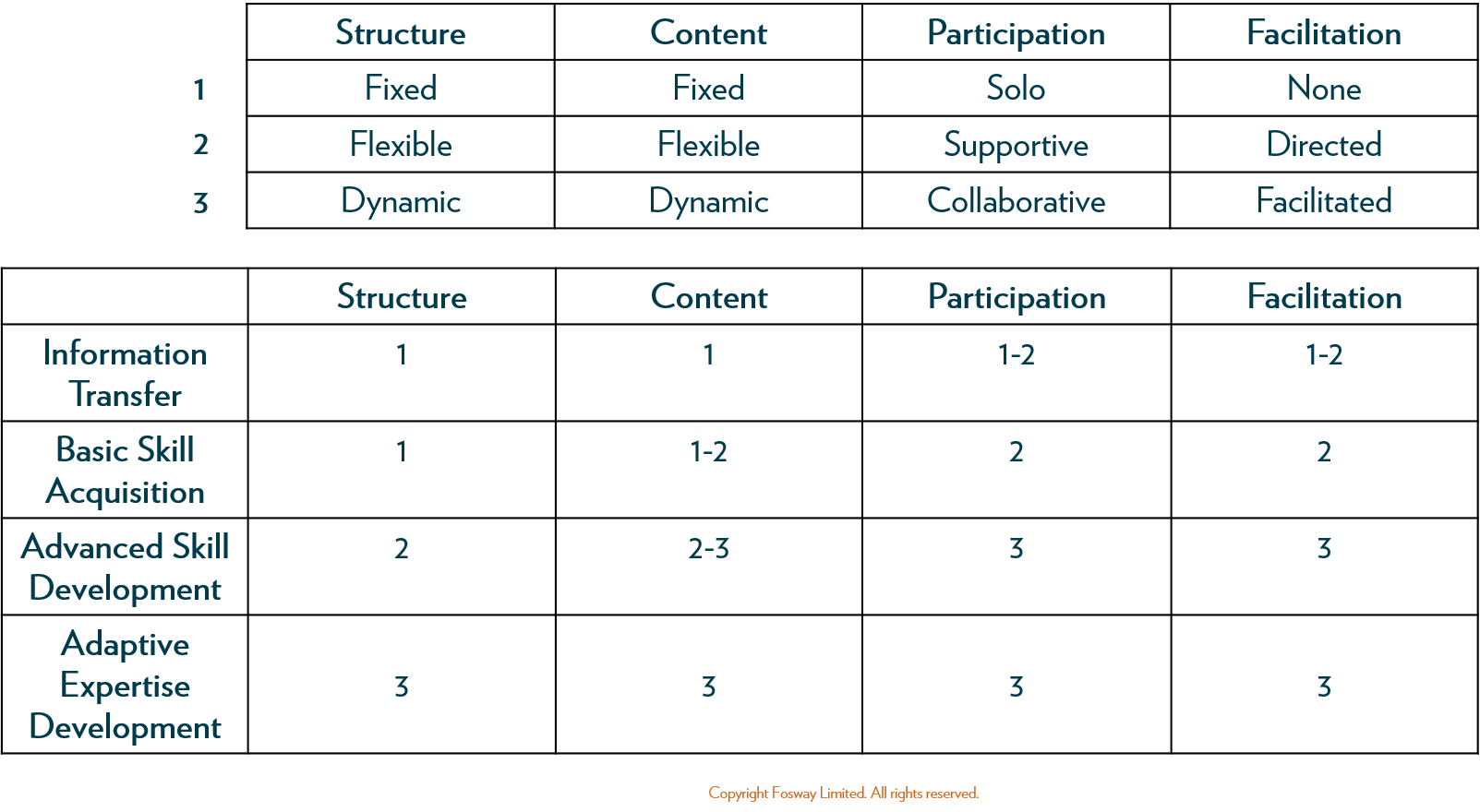
The matrix can be applied to defined learning requirements and gives us a clearer understanding of the relative role of the different components. It tells us whether fixed learning structures are appropriate, whether content needs to be flexible in form (multiple types), and the degree of collaboration or instruction needed.
Looking at where the three examples fit into the E-learning Dynamics Matrix:
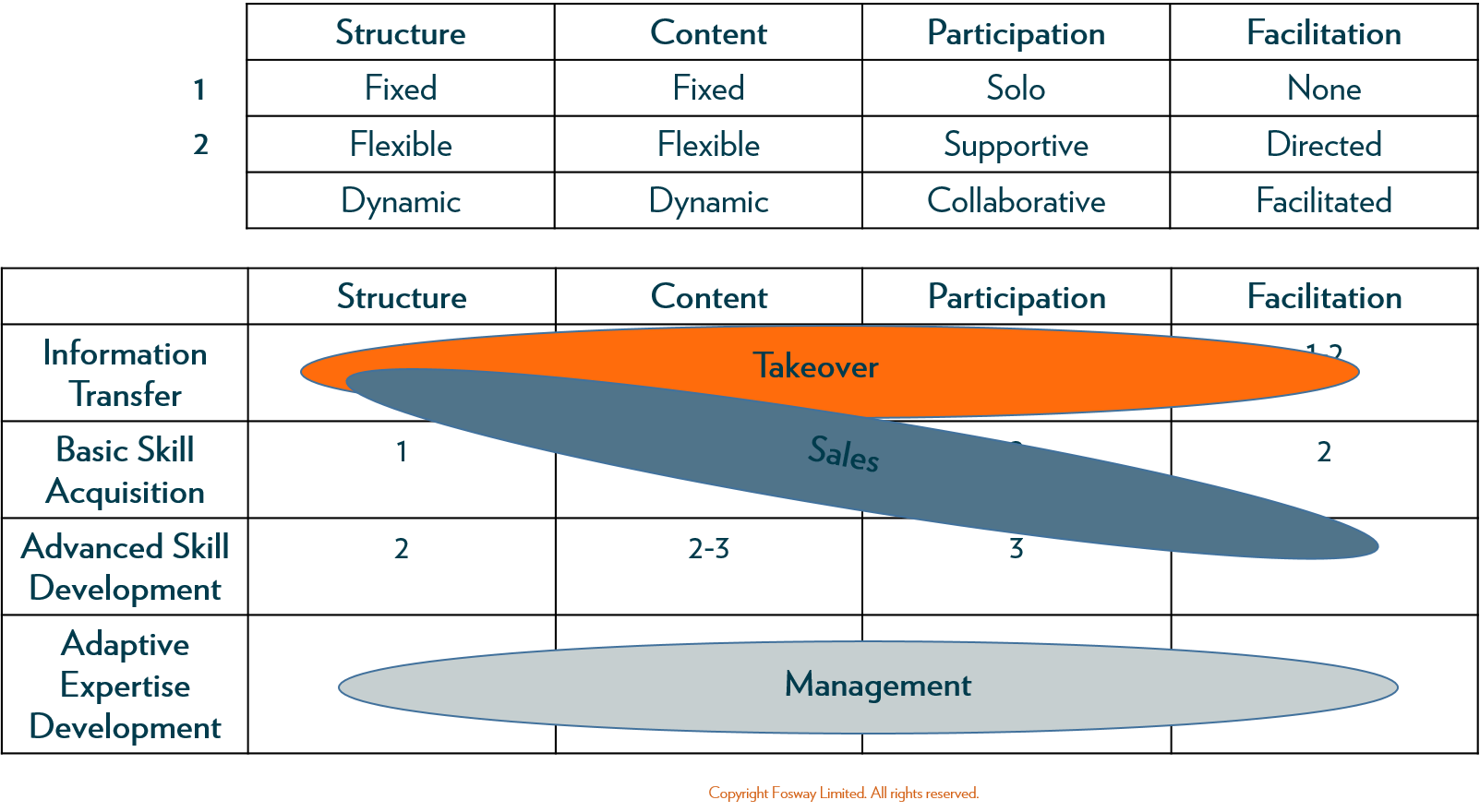
Applying the E-learning Dynamics Matrix to our three examples might look like the following:
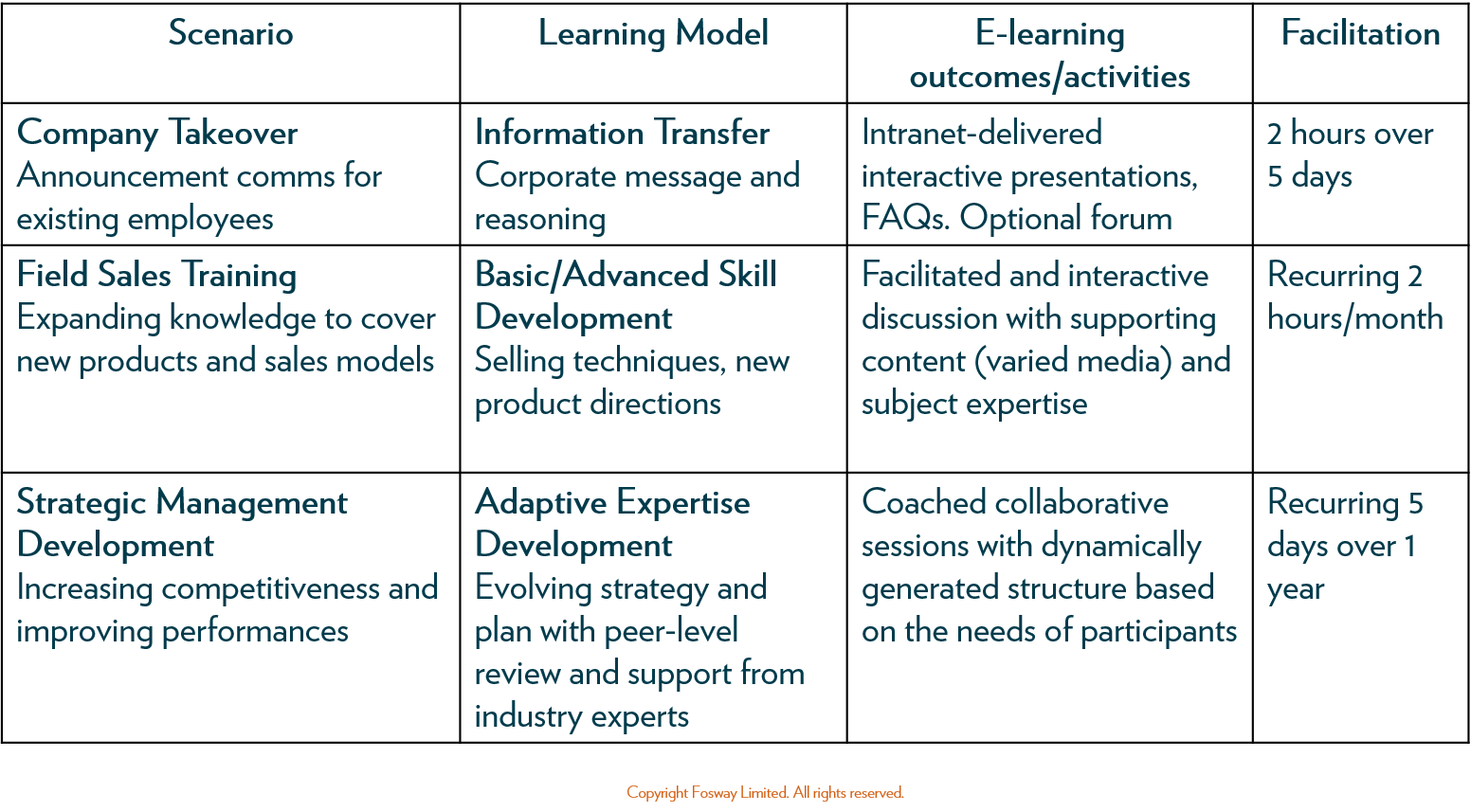
As you can see from the table, the application of the simplified E-learning Dynamics Matrix enables us to map from a Learning Model to an E-learning Outcome which outlines a learning approach and learning activities. This approach can then be mapped into an e-learning technical design, which defines the characteristics of the underlying technology and helps to determine the types of products we need.
Of course, this mapping process is not the whole answer. There are other important factors, including the specific subject matter itself and how that lends itself to online representation. Also we need to consider the needs of the students, delivery logistics, technology and infrastructure, longer-term strategy and so on.
But, by understanding the underlying nature of the learning requirement and the key dynamics of learning associated with it, we can at least start to map out a sensible way of delivering it, to ensure we are constructing an e-learning approach where we deliver real learning value.
Zusammenfassung
Erfolg im E-Learning hängt von drei Schlüsselbereichen ab. Erstens ist ein umfassendes Verständnis aller verschiedenen Komponenten erforderlich – von Lernmanagementsystemen bis hin zu Techniken der Inhaltsentwicklung, von der IT-Infrastruktur bis hin zum Lerndesign und dem Management von organisatorischen Veränderungen. Da E-Learning-Programme selten kostengünstig sind, ist es zweitens entscheidend, eine hohe Rendite für die Anfangsinvestition zu erzielen; daher ist der Einsatz möglichst erfahrener Ressourcen für den Erfolg unerlässlich. Der Wert derjenigen, die ‘das schon einmal gemacht haben’, ist nicht zu unterschätzen. Und schließlich ist es unerlässlich, diese Komponenten, Geschäftsfunktionen und Ressourcen zu koordinieren und zu verwalten. E-Learning überschreitet viele Grenzen und sollte als strategisches Vorhaben betrachtet und als ein wirklich funktionsübergreifendes Programm gemanagt werden.
Wir hoffen, dass Ihnen die Artikel der Reihe ‘Rezepte für erfolgreiches E-Learning’ geholfen haben, einige der aktuellen Fragestellungen zu diesem Thema zu verstehen und Sie dazu angeregt haben, Ihre Ideen zum E-Learning zu überdenken. Fosway forscht und entwickelt kontinuierlich bewährte E-Learning-Praktiken und konzentriert sich darauf, sein Wissen und seine Erfahrungen mit seinen Kunden und E-Learning-Praktikern zu teilen.
Weiterführende Artikel von Fosway
Die anderen Artikel in dieser Reihe sind wie folgt:
• Rezepte für E-Learning-Erfolg
• Die Volumen-versus-Wert-Gleichung
• Blended Learning oder Integriertes E-Learning?
• Aufbau von Lerngemeinschaften
• Synchron vs. Asynchron
• E-Learning-Standards
Entscheidigungen beschleunigen und Risiko vermeiden
Um mit uns über unsere Forschung zu Lern- und Talent-Systemen zu sprechen oder um zu erörtern, was dies speziell für Ihr Unternehmen bedeuten könnte, kontaktieren Sie uns bitte direkt.
Wir werden unsere unabhängige Expertise nutzen, um Ihnen die Anleitung zu geben, die Sie benötigen, um Ihre Entscheidungen zu beschleunigen und Risiken zu minimieren. Uns stehen eine Fülle von Erfahrungen, Werkzeugen, Forschungsergebnissen und Profilen zur Verfügung.
Wir haben keine Produkte zu verkaufen und kein Eigeninteresse, das Ihre Ergebnisse beeinflussen könnte. Wir konzentrieren uns auf pragmatische, unabhängige Beratung.
Richtigkeit der Informationen und Gewährleistungen
Die in diesem Dokument vorgenommenen Analysen und Empfehlungen basieren auf den Fosway derzeit vorliegenden Informationen und aus Quellen, die als zuverlässig gelten.
Fosway schließt alle Gewährleistungen hinsichtlich der Richtigkeit, Vollständigkeit oder Angemessenheit solcher Informationen aus. Fosway übernimmt keine Haftung für Fehler, Auslassungen oder Unzulänglichkeiten der hierin enthaltenen Informationen oder für deren Auslegungen.
Die hier geäußerten Meinungen können ohne Vorankündigung geändert werden. Der gesamte Inhalt ist urheberrechtlich geschützt durch Fosway Limited, sofern nicht anders angegeben. Alle Rechte vorbehalten.
Über Fosway Group
Bei Fosway Group verstehen wir, dass die Entwicklung und Einbindung von Mitarbeitern der Schlüssel für komplexe globale Organisationen ist, um Leistung zu erbringen und Erfolg zu erzielen. So einzigartig wie die Talententwicklung jedes Mitarbeiters ist, so einzigartig ist auch die Personalstrategie jeder Organisation.
Die Analyse- und Beratungsdienste der Fosway Group liefern Ihnen die Erkenntnisse, die Ihr Unternehmen benötigt, um Ergebnisse zu erzielen und Risiken zu eliminieren. Wir wissen, dass jeder Aspekt von HR und Talentförderung der nächsten Generation stärker miteinander verknüpft ist als je zuvor. Wenn Sie mit uns zusammenarbeiten, beschleunigen Sie Ihre Erkenntnisse und treffen bessere Entscheidungen.
Wir sind Europas unabhängiger HR-Analyst #1, und genau wie die römische Straße, nach der wir benannt sind, werden Sie feststellen, dass wir ungewöhnlich direkt sind. Wir haben kein Eigeninteresse an Ihren Entscheidungen in Bezug auf Technologie oder Beratung. Sie können sich darauf verlassen, dass wir Ihnen sagen, was Sie wissen müssen, um erfolgreich zu sein.
Beispiele für Kunden sind: Alstom, Aviva, Boots UK, BP, BT, Centrica, Deutsche Bank, Faurecia, HSBC, International SOS, Lloyds Banking Group, Novartis, PwC, Rolls-Royce, Royal Bank of Scotland, Sanofi, Shell, Swiss Re, Telefonica, Thomson Reuters, Toyota Europe und Vodafone.
Kontaktieren Sie uns
Sprechen Sie heute mit unserem Analystenteam über Ihre Anforderungen an das Talentmanagement und erhalten Sie Einblicke in Ihren Beschaffungsprozess und Ihre strategischen Entscheidungen. Kontaktieren Sie uns online oder rufen Sie +44 (0)20 7917 1870 an oder senden Sie eine E-Mail info@fosway.com.
 Deutsch
  English (UK)
  Français