


Productivity is now the priority for TA spend
Published in May 2026, the Fosway 9-Grid™ for Talent Acquisition looks at the recruiting technology market for EMEA’s TA leaders – here, Fosway analysts look at where TA spend is now being prioritised.
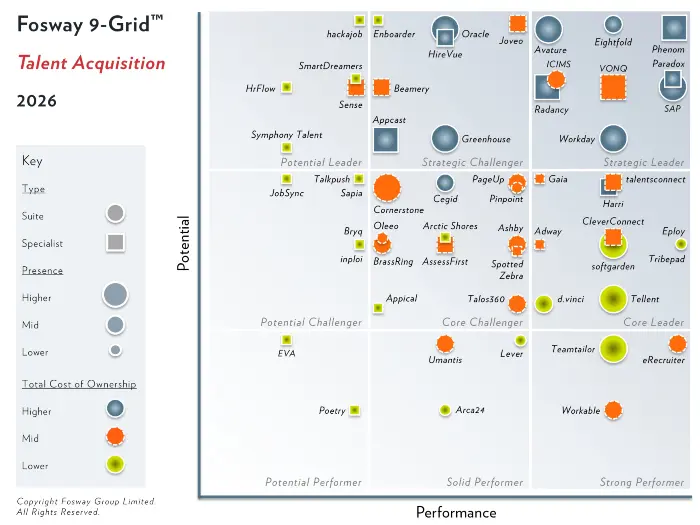
In Europe, TA budgets are under pressure, but the pressure is not felt evenly across the TA process model. TA technology investment is more defensible where organisations seek to improve recruiter productivity, decision quality or compliance in the recruiting process.
TA leaders are closely scrutinising volume-led spend and cutting back where it creates candidate flow without clear evidence of quality, conversion or time to value. This pressure is also pushing candidate acquisition providers to show how their reach creates productivity gains for buyers. Many are using AI and data to move beyond volume and deliver better-qualified candidate flow into employer TA funnels. Access to candidates is no longer enough to protect TA budget. Suppliers need to demonstrate how they improve productivity, quality and hiring outcomes.
AI hiring accountability lands with the employer
Employers now need to prove how AI in hiring is governed, configured and used. For European organisations, supplier claims about responsible AI and bias testing are not enough. The employer itself must prove how AI impacts its hiring process. This matters most when AI has a direct role in candidate screening, matching, ranking, assessment, interview interpretation or rejection, rather than in lower-risk use cases such as drafting content or scheduling. This puts new operational demands on the TA operating model.
It is already slowing some AI adoption, especially in selection, but it will also separate credible deployments from ‘AI theatre’. Vendors may provide tooling, documentation, configuration records, and audit logs, but they cannot prove that the employer’s end-to-end hiring process is sound, fair or appropriately governed. For employers, the risk is not just poor AI use; it is being unable to explain and justify how AI influenced a hiring outcome when challenged.
Pay transparency makes intake a public control point
The EU Pay Transparency Directive is not just a compensation issue. It makes weak intake meetings visible before a role reaches the market. In many organisations, requisitions are often opened before job level, pay range, location assumptions, skills requirements and approval exceptions are fully agreed. Reward and HR may own the underlying job and pay architecture, but TA exposes any inconsistency when a role goes to market. That was always an issue, but pay transparency now makes it visible to candidates and employees and increases regulatory exposure.
This is especially complex in Europe, where collective agreements, works council expectations, internal equity rules and location-based pay can all shape what can be advertised or negotiated. Recruiters will be expected to manage clearer pay information and more consistent candidate conversations. But they cannot fix weak job architecture or compensation governance once the role is already in market. Pay transparency therefore turns intake meetings from process hygiene into a control point for compliance, fairness and employer credibility.
+++
This is an excerpt from the Fosway 9-Grid™ for Talent Acquisition. Get the full insight and discover all the latest market and solution trends by reading the whole report here.
What should you do next?
- Add your voice to our Talent Acquisition Realities research – it’s the essential benchmarking resource for EMEA’s recruiting and resourcing leaders.
- The update is here – read the 2026 AI Market Assessment for Talent Acquisition. What’s improved (and what needs work)? Find out today.
Other recommended reading
- The 2025 Fosway 9-GridTM for Cloud HR – full report. Released in September 2025, it’s the latest market and solution trends in Cloud HCM.
For corporates looking for deeper insight on this and other similar topics, please consider joining our Fosway research network to get access to corporate roundtables, private 1-1 analyst time, benchmark reports and other analyst services or project support. Click here to find out more.
Please also visit the Fosway Knowledge Centre.
Check out other relevant Fosway research and insights, including filters for segment category, key topics, type of content and vendor-specific information.
 English (UK)
  Deutsch
  Français