


The 2026 hiring market is cautious
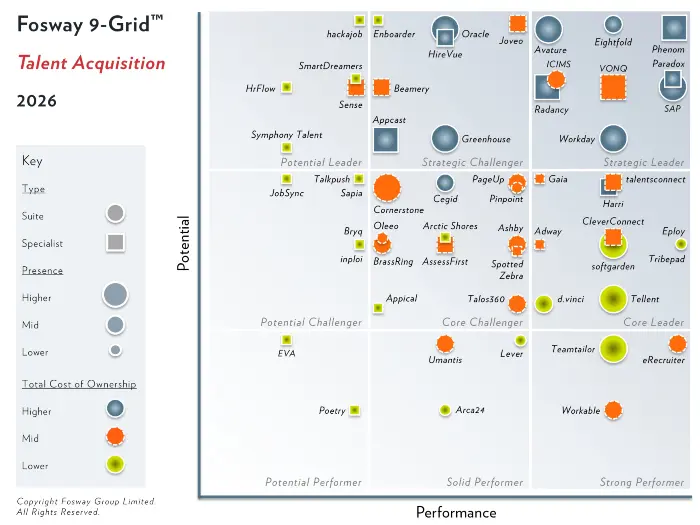
Published in May 2026, the Fosway 9-Grid™ for Talent Acquisition looks at the recruiting technology market for EMEA’s TA leaders – here, Fosway analysts look at the dynamics of the 2026 hiring market .
Hiring in Europe is polarised and fragmented. Weak business growth, cost pressure and geopolitical uncertainty are making many employers more cautious, but structural shortages remain in many industries and critical technical skills. With AI now adding to the pressure on entry-level and process-heavy work, hiring for historically high-demand roles such as software engineering and marketing is now well below previous peaks.
AI-generated applications, easier apply flows and candidate automation are creating fuller funnels without necessarily improving candidate quality or availability. Vendor revenues reflect the same pressure, with growth rates flat or declining in many parts of the TA market. Providers that rely heavily on job distribution or programmatic advertising are more exposed. For TA leaders, the challenge is to separate genuine labour-market constraint from internal demand uncertainty.
The requisition is no longer the starting point for TA
With greater economic pressure on headcount and AI changing how work gets done, organisations are challenging the need to hire more profoundly. This matters more in Europe because headcount decisions are high-commitment decisions, influenced by employment protections, works councils and historically slower growth in most of the continent.
The decision is not just whether a role is affordable or value-creating enough to open, but which tasks will remain with humans, where the work should be located, and whether it is a permanent hire at all. Location choices now go beyond labour cost and need to reflect skills availability and geopolitical resilience. This forces TA into a broader workforce conversation before external hiring starts, and TA leaders must be part of that conversation.
Enterprise hiring portfolios are more polarised
The old language of hiring freezes and hiring recovery is too blunt for the 2026 talent acquisition market. Organisations are still hiring where the opportunity cost of a vacancy is immediate, especially for revenue-critical, frontline and scarce-skill roles. At the same time, entry-level, desk-based, process-heavy roles are facing a tougher test.
Finance and business leaders are asking harder questions about the value of new hires and AI is making desk-based task substitution easier. This is not just normal prioritisation between job roles: recruiters need to move fastest on roles where the impact of vacancy is immediate, and slow down where redesigned work has not yet become a clear hiring brief. They also need to keep warm pipelines for roles that may be approved later or shifted to different locations as plans change. The result is a more unstable hiring portfolio. TA impact comes less from processing every requisition equally and more from helping the business decide which requisitions need prioritising, which need more scrutiny and which should not become hires at all.
This is an excerpt from the Fosway 9-Grid™ for Talent Acquisition. Get the full insight and discover all the latest market and solution trends by reading the whole report here.
What should you do next?
- The survey is still open for late feedback – add your voice to our Talent Acquisition Realities research.
- Build your evidence-based AI strategy with Europe’s most experienced HR industry analysts. Sign up here.
Other recommended reading
- The 2026 update is imminent – before it arrives, read the 2025 AI Market Assessment for Talent Acquisition. How will the landscape have changed?
- The 2025 Fosway 9-GridTM for Cloud HR – full report. Released in September 2025, it’s the latest market and solution trends in Cloud HCM.
For corporates looking for deeper insight on this and other similar topics, please consider joining our Fosway research network to get access to corporate roundtables, private 1-1 analyst time, benchmark reports and other analyst services or project support. Click here to find out more.
Please also visit the Fosway Knowledge Centre.
Check out other relevant Fosway research and insights, including filters for segment category, key topics, type of content and vendor-specific information.
 English (UK)
  Deutsch
  Français