


Learning standards are under pressure
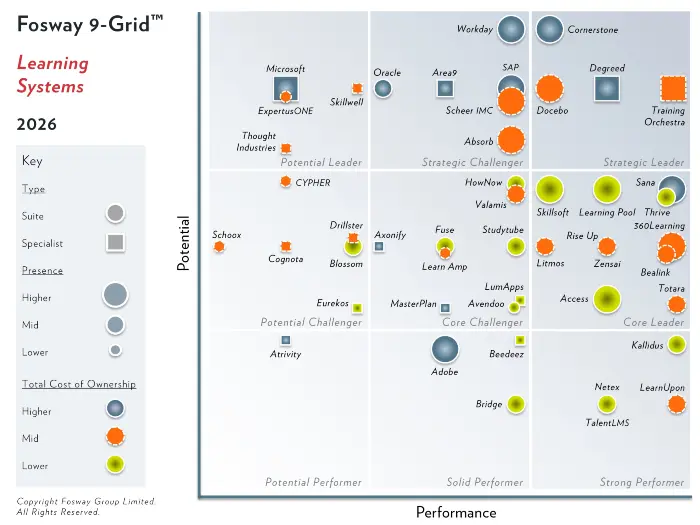
Published in February 2026, the Fosway 9-Grid™ for Learning Systems looks at the learning management solutions market for EMEA’s learning leaders – here, Fosway analysts think an overhaul of learning standards might be under way.
Standards have long been positioned as the foundation of interoperability in digital learning. SCORM, xAPI and related frameworks were designed to ensure portability, tracking consistency and vendor neutrality. In practice, however, implementation has often been inconsistent. A new pressure point is emerging. Corporates are increasingly seeking tools that can allow AI agents to crack open SCORM packages directly to extract richer learning data.
As expectations around analytics and AI-driven insight rise, organisations want to ‘open up’ historical content and recover value locked inside legacy course files. The irony is that SCORM itself is not truly standard in its packaging. Variations in authoring tools and even between versions of the same tool can alter packaging and data structures making access challenging, even for AI. Will this still be necessary in the future?
With AI fundamentally reshaping rapid content creation and replication, the need for some learning standards may diminish along with the content libraries that adopt them.
Invest for success, but what does it cost?
In previous reports we have talked about the importance of understanding your true cost of ownership and investing in the right areas to ensure your success. Too many buyers just focus on license costs and implementation, rather than the real cost of achieving sustained success, such as ongoing operating costs, support, and most critically, the cost of innovation. Missing the latter when the platform you use innovates all the time is a big mistake. It means you lock your value to what you originally implemented, not what you need in the future. That makes no sense, especially in a SaaS world where platforms constantly evolve, as do your own requirements.
Going forward, you need to add in the cost of AI too. Whilst a lot of transactional AI cost is embedded in license fees, a lot potentially won’t be, requiring tokens or whatever model vendors operate to access premium AI features for more transformational capabilities and deliverables. The expectation is still that AI will generate a lot of revenue for the hyper-scalers (as well as the chip manufacturers). That must be coming from somewhere, and the logical answer is from the application vendors and their customers. At the moment, AI pricing still feels a bit like the wild west – sometimes it is visible, sometimes it is not. But whatever vendors say, someone, somewhere is going to be paying for it!
This is an excerpt from the 2026 Fosway 9-Grid™ for Learning Systems. Get the full insight and discover all the latest market and solution trends by reading the whole report here.
What should you do next?
- You can read the full 9-Grid™ for Learning Systems report here – an unrivalled depth of LMS and LXP market insight that no other learning systems market analysis tools can match.
- The Learning Systems AI Insights 2026 Market Assessment provides buyers with a clear analysis of the AI innovation in the Learning Systems market – read our latest critical research here.
- Digital Learning Realities 2026 – share your experience of digital learning, get first look access to the results, and benchmark your progress.
Other recommended reading
- Build your AI strategy with evidence, not guesswork. All our published research so far is here >> Fosway AI Strategic Research Programme
For corporates looking for deeper insight on this and other similar topics, please consider joining our Fosway research network to get access to corporate roundtables, private 1-1 analyst time, benchmark reports and other analyst services or project support. Click here to find out more.
Please also visit the Fosway Knowledge Centre to check out other relevant Fosway research and insights, including filters for segment category, key topics, type of content and vendor-specific information.
 English (UK)
  Deutsch
  Français