


HR’s next test – AI agents
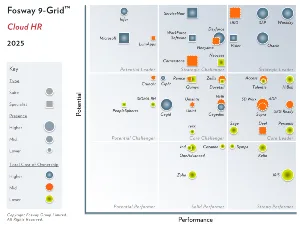
Published in September 2025, the Fosway 9-Grid™ for Cloud HR looks at the market for Suites and Specialist platforms in the Cloud HCM space. Here, Fosway analysts look to the next iteration of the AI chatbot.
The next stage beyond basic copilots are AI agents, where systems begin to act (semi-) autonomously within defined guardrails. Early examples include agents that process timesheets and agents that recommend redeployment options or suggest schedule swaps in line with labour rules. The real shift comes though with collaborative agentic frameworks where multiple agents interact and provide answers or actions to each other.
This requires a strong infrastructure layer for multi-agent collaboration and exposes one of the hardest challenges for HR in EMEA; most HR data falls under GDPR and local labour law, demanding explicit consent or contractual authorisation before third-party agents can get access to it. As a result, agentic deployments remain in narrow use cases, with most still in pre-production, and with humans in the loop. Vendors that prove explainable and compliant cross-agent execution in live environments will set the pace, but it is early days and the journey from copilots to agents is only just beginning.
AI control sits with IT, but the pendulum is swinging back to HR
In many organisations, HR has already lost the first battle of who really controls AI decisions. For companies that have invested heavily in LLMs, CIOs are desperately looking for meaningful AI applications to justify the spend. Self-built agents for primary business processes are one thing, but HR agents developed in-house are already proving difficult to build and even more difficult to maintain. They also have to be retested with every new version of the underlying LLM, and every answer needs to be 100% correct or companies might risk finding themselves in court.
But what is worse is AI also massively relies on accurate data and context from policies, legal frameworks (including edge cases) and individual employee context. Several HR vendors are building global HR compliance portals by continually scraping and updating relevant legislative changes from government websites. But whilst this makes sense for global providers, the effort to do it for one company seems unwarranted for an internal team that just wants to develop a copilot or agent to handle time or pay enquiries. HR and IT need to work together to identify which copilots/agents are better to live inside the HR ecosystem, and which ones don’t.
This is an excerpt from the Fosway 9-Grid™ for Cloud HR. Get the full insight and discover all the latest market and solution trends by reading the whole report here.
What should you do next?
- The AI Market Assessment for Cloud HR is live – get the AI market insight into HR you won’t find anywhere else, here.
- What’s the future of Cloud HCM in the age of AI-powered HR tech? Sign up to be involved in Phase Two of Fosway’s ongoing strategic project: ‘AI in HR’.
Other recommended reading
- How will HR redesign work in the AI era?
- Browse the Knowledge Centre for other Fosway research related to AI and Cloud HR.
For corporates looking for deeper insight on this and other similar topics, please consider joining our Fosway research network to get access to corporate roundtables, private 1-1 analyst time, benchmark reports and other analyst services or project support. Click here to find out more.
Please also visit the Fosway Knowledge Centre.
Check out other relevant Fosway research and insights, including filters for segment category, key topics, type of content and vendor-specific information.
 English (UK)
  Deutsch
  Français