


How will HR redesign work in the AI era?
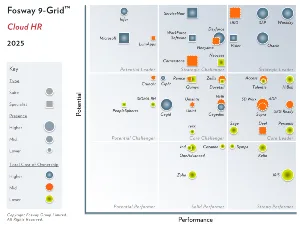
Published in September 2025, the Fosway 9-Grid™ for Cloud HR looks at the market for Suites and Specialist platforms in the Cloud HCM space. In this excerpt from the report, Fosway analysts look at the changing nature of work itself.
While consolidation equips suites with innovation in recruiting and other specialist talent processes, the harder AI challenge for most EMEA organisations lies in redesigning work itself. Fosway research shows that AI and the future of work, specifically managing the impact of AI, automation and robotics, now sit among HR’s top priorities. The noise of AI is loud, yet most HR leaders no longer consider it overhyped: They expect AI will deliver a material impact but still require real proof that agentic approaches can work at scale. But AI will not transform a business just by auto-drafting job descriptions or inferring skills.
The real challenge though is work redesign, deciding which tasks move to AI agents, which remain with people, and at what pace by function and country. In EMEA, works councils and safety regimes require documented impact assessments and human oversight over AI, shaping scope, sequencing and timelines. These changes pull HR alongside the COO and CFO and extend HR’s role from service delivery to work design, upskilling and redeployment. Our research shows that strategic workforce planning, skills and analytics are going to see the most significant increase in HR tech spend across the coming years in EMEA.
Cloud HR Suites still lack the link between work and skills
To support AI transformation, many large enterprises have already invested in skills platforms, internal mobility and strategic workforce planning. That has helped manage the operational aspects of change, but the fragmented and sporadic treatment of task-level data within HR suites has limited HR’s ability to lead this transformation.
Vendors must act quickly to elevate work tasks from hidden attributes to structured, connected data objects. Tasks need to sit between jobs and skills, mapped into living job architectures and exposed through open APIs. Without this, HR must rely on external tools to model the impact of automation and design redeployment and reskilling programmes, when this should be core to the HR suite itself. Smaller enterprises can follow a lighter path: a simple job architecture map, a baseline skills inventory and a regular planning cadence tied to Financial Planning & Analysis (FP&A).
Skills investment shifts from mapping to planning
Whilst Fosway’s research shows some progress on the growth of skills-based organisations in EMEA, doing this at scale remains rare. Where there is value, it comes from hard outcomes such as faster redeployment, reduced external hiring for critical roles and better workforce agility, not from skills dashboards or reports. The success pattern is clear: put in place a single job and skills architecture owned jointly by HR, finance and operations with validated skills data tied to tasks and credentials, as well as planning cycles that use this data for scenario modelling and real budget decisions.
In most companies, ecosystem fragmentation still limits full global adoption, typified by multiple taxonomies across recruitment, learning and talent. Low trust in inferred skills without manager validation, or uneven links to pay, career pathing and compliance remain challenges too. Regulated professions suffer additional friction as credentialing and CPD limit informal skills recognition. But for many buyers, the next phase is execution, not mapping. Buyers seek skills data that enables planning and pay transparency, and informs strategic decisions including automatic audit trails and country-specific governance. Vendors need to prove an end-to-end process or risk being deprioritised.
This is an excerpt from the Fosway 9-Grid™ for Cloud HR. Get the full insight and discover all the latest market and solution trends by reading the whole report here.
What should you do next?
- The AI Market Assessment for Cloud HR is coming soon – get an overview of the project and published papers so far, here.
- What next for AI and the world of HR technology? Sign up to be involved in Phase Two of Fosway’s ongoing strategic project: ‘AI in HR’.
Other recommended reading
- 79% of HR leaders plan to use more AI – find out how in this insights post.
- Browse the Knowledge Centre for other Fosway research related to AI and Cloud HR.
For corporates looking for deeper insight on this and other similar topics, please consider joining our Fosway research network to get access to corporate roundtables, private 1-1 analyst time, benchmark reports and other analyst services or project support. Click here to find out more.
Please also visit the Fosway Knowledge Centre.
Check out other relevant Fosway research and insights, including filters for segment category, key topics, type of content and vendor-specific information.
 English (UK)
  Deutsch
  Français