


Will AI end the fixation on the ‘Netflix’ experience?
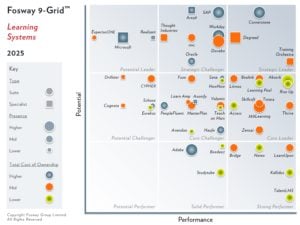
Published in February 2025, the Fosway 9-Grid™ for Learning Systems looks at the market for Suites and Specialist platforms in the learning technology space. Here, Fosway analysts ask how much longer the Netflix metaphor will last – and what part AI could play in its demise.
The early days of the learning experience story were dominated by vendors aiming (or claiming) to be ‘the Netflix of learning’. The use of personalised recommendations, often aligned to the choices of other learners in similar roles, and then increasingly to skills needs as well as mandatory learning became the metaphor du jour, increasingly dominating the learner interfaces of most learning systems. An alternative but generally niche strategy was always to view the learning system as a back-end transactor of learning access and delivery, embedding the point of access elsewhere, e.g. in business or workplace applications. This gave rise to the concept of a headless learning system, where the head or access point was outside of the learning system.
In a world increasingly dominated by AI assistants and coaches, and AI-generated learning on the fly, that concept becomes even more interesting (or challenging depending on your perspective). Interestingly, that concept also applies to other learning roles too, not just the learner. It is not difficult to imagine the main interface for trainers and managers going the same way, and we shouldn’t ignore the potential for AI-led processes and automation for administrators too.
Understanding your real cost of ownership
Every vendor provides a price during a tender process based on very different criteria. It can be confusing and rarely possible to compare like with like. There are the basic licence bands depending on the range of learners from a few hundred to tens of thousands of learners, but these can be the number of named users per year or even active users per month (often for customer and partner education). But the true ‘total cost of ownership’ is not just down to the licences. Services such as the support (standard or premium) of a customer success manager may or may not be included in the licence price. Implementation, integration with other parts of the ecosystem, languages also need to be added.
And now on top of that, you have the costs associated with AI. The expectation is that AI will generate a lot of revenue for the hyper-scalers (as well as the chip manufacturers). That has to be coming from someone, and the logical answer is from the application vendors. At the moment, it still feels a bit of the wild west with AI pricing. Sometimes it is visible, sometimes it is not. But someone, somewhere is paying for it!
Investing in implementation and integration is critical
Buyers purchase the best learning systems available to suit their requirements, but often after a few years become disillusioned and unhappy. There are many reasons why this is the case. Sometimes they didn’t buy the right system, e.g. buying something too simple or too complicated for their real needs. This happens more than you think – maybe up to 50% of the time, from our research. But the other risk is they bought the right solution, but failed to implement it very well, resulting in a sub-optimal experience. That also happens more frequently than you would expect. In fact, it is very common. Investing properly in implementation is critical, as is making the right decisions in planning, configuration, change management, and integrations.
One area which is very prone to being sub-optimal is how the system integrates with the rest of the ecosystem. Learning needs to be accessible from wherever the employee spends their working day, and is able to leverage learning content and resources from wherever they are created and stored. Doing this well and in a frictionless way has become a critical factor in the success of learning systems. Vendors will say that APIs solve this problem, but building integrations requires integrators, i.e. developers and other experienced people to build and maintain them. In a complex company, that is non-trivial and often very expensive. In mid-market companies it is almost impossible, as they lack the resources and budgets to develop and maintain their own integrations. The more integrations are out-of-the-box using easy connectors, the better off all buyers will be.
This is an excerpt from the Fosway 9-Grid™ for Learning Systems. Get the full insight and discover all the latest market and solution trends by reading the whole report here.
What should you do next?
- Sign up to be part of Digital Learning Realities 2025 – ignore the hype and be part of the reality of modern digital learning. Share your experiences in this year’s research cycle here.
- Discover the future of personalised learning. Engage with Fosway’s strategic AI project for 2025: ‘AI in Learning’.
Other recommended reading
- Personalised learning – training you can’t afford to ignore. In an economic downturn it is essential to demonstrate value to prevent budgets being cut.
- The 2025 Fosway 9-GridTM for Digital Learning– full report. Released in 2025: the latest look at the market and solution trends in learning content providers – get the full analysis today.
- Disruptive Insights: Large Enterprise Learning. The Learning Systems market has evolved a lot over the last 25+ years. With origins in managing training, through the growth of e-learning and virtual training, Fosway has been there, providing analysis, for its whole evolution.
For corporates looking for deeper insight on this and other similar topics, please consider joining our Fosway research network to get access to corporate roundtables, private 1-1 analyst time, benchmark reports and other analyst services or project support. Click here to find out more.
Please also visit the Fosway Knowledge Centre to check out other relevant Fosway research and insights, including filters for segment category, key topics, type of content and vendor-specific information.
 English (UK)
  Deutsch
  Français