


AI is redefining coaching
Published in March 2026, the Fosway 9-Grid™ for Digital Learning looks at the learning content market for EMEA’s business leaders – here, Fosway analysts look at how AI is redefining coaching services.
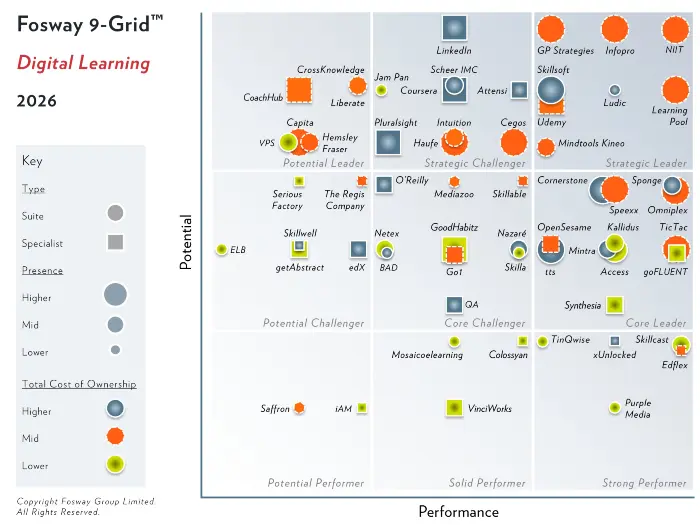
Last year saw an invasion of AI assistants, and this year has seen the relentless march of AI coaching tools of varying types and levels of capability. Conversational role play and practice has become a new AI staple in learning design and experience, with the ability to practise skills with an AI conversational partner now a common feature of platforms, programmes and libraries. Sophistication of these tools is advancing as scenario selection and creation are built in and configuration of personality, role and tone of the AI is available. Often replacing traditional quizzes and interactive media, these tools can offer genuine challenge and reflection that was rare in traditional e-learning until now.
AI coaching is emerging as a new standalone sub-segment as businesses and products are launched alongside human coaching services. The deeper benefits and effectiveness of AI coaching are yet to be properly understood. But promising wider access than executive coaching historically, and more democratic pricing, AI coaching plays by different rules and is not, yet, being positioned as a substitute for human services.
Differentiating through AI remains problematic
As for last year, vendor roadmaps and R&D activity have been dominated by AI. But in pure product terms, sustainable differentiation remains elusive. The foundation LLMs, available to all, catch up with each other every step forward, and any moats being built around each provider are, so far, shallow. In the off-the-shelf segment, the race to keep up has further blurred the market as functionality advances. New learning products are emerging as standalone offers or bundled with library subscriptions all the time. AI role play is everywhere and in custom programme development, efficiencies in design, production and learner experience are being introduced in most studio workflows. Some daylight is emerging though between providers in their underlying content quality, service and data capability, and content containing proven deep expertise and insight, particularly in specialist topics, is more valuable.
The vendor brands that signal this provenance to customers and learners will retain an advantage, especially where the intellectual property can be restricted from becoming ubiquitous. Genuinely good storytelling still matters (and is as rare as ever). Understanding and defining valuable problems, along with the evidence that justifies their solution, is becoming a highly valued capability as budget holders seek to consolidate costs and focus on high business priorities with demonstrable impact. Data is the real foundation of AI, as it always should have been for digital learning. Progressive providers have invested faster in data management infrastructure and analytics tools to support their ability to scale customer solutions efficiently.
Innovation potential emerges in compliance
With deeply established structures and practices, as well as often conservative behaviour from buyers, compliance learning has been the most resistant to change of all digital learning segments. There are signals though that this is beginning to change. As we have seen throughout this report, the combination of economics and AI is disrupting legacy patterns. This impacts compliance too. The opportunity to personalise compliance learning experiences through conversational AI can unlock significant time savings for learner populations.
The ease of adding multiple formats and modes in learning design, supported by AI authoring, is also raising expectations for better experiences as well as greater efficacy. The use of AI translation throughout learning workflows is a leading indicator of this change, enabling a scale of delivery at substantially lower cost. Most significantly, AI is also rapidly advancing analytics and the reporting of compliance data, going beyond retrospective dashboards, and moving towards the active management of actual risk.
This is an excerpt from the Fosway 9-Grid™ for Digital Learning. Get the full insight and discover all the latest market and solution trends by reading the whole report here.
What should you do next?
- New this week: Fosway’s Digital Learning Realities 2026 research – browse the first cluster of infographics today.
- You can read the full 9-Grid™ for Digital Learning report here – learning content market insight that no other analyst can match.
Other recommended reading
- AI is supercharging self-study – Fosway analysts look at self-study in digital learning.
- Build your AI strategy with evidence, not guesswork. All our published research so far is here >> Fosway AI Strategic Research Programme
For corporates looking for deeper insight on this and other similar topics, please consider joining our Fosway research network to get access to corporate roundtables, private 1-1 analyst time, benchmark reports and other analyst services or project support. Click here to find out more.
Please also visit the Fosway Knowledge Centre to check out other relevant Fosway research and insights, including filters for segment category, key topics, type of content and vendor-specific information.
 English (UK)
  Deutsch
  Français