


Cohort-based learning is still overlooked
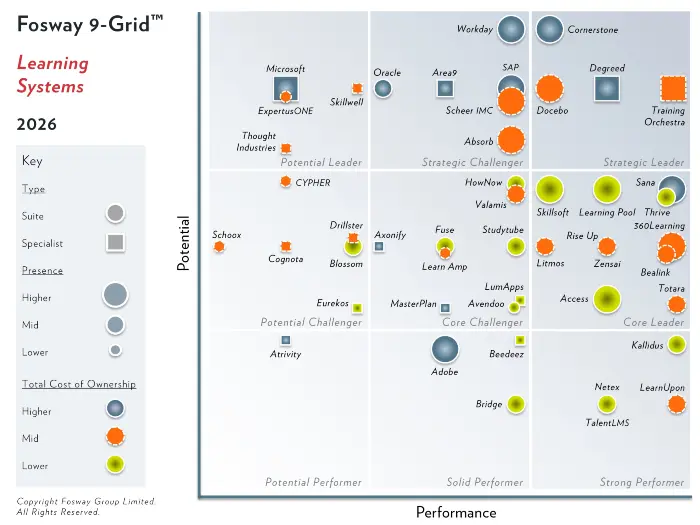
Published in February 2026, the Fosway 9-Grid™ for Learning Systems looks at the learning management solutions market for EMEA’s learning leaders – here, Fosway analysts look at the continuing importance of cohort-based learning.
Cohort-based learning, often delivered in large-scale in-person corporate programmes, continues to play a major role in people development but a neglected one in their learning systems. Cohort-based learning is not about content consumption; it is about peer networking, shared context and the embedding and development of critical skills. Despite its importance, and the spend associated, this segment is still largely ignored by the digital learning industry. Whilst technology vendors focus heavily on AI-driven personalisation, automation and content delivery at scale, they totally underplay learning as a collaborative activity. Given the challenges posed to learning by AI, paradoxically, this may be one of the few areas least susceptible to full AI substitution.
Leadership, surgical precision, craftsmanship, complex negotiation, are all capabilities refined through guided practice, feedback, observation and peer interaction. AI may support preparation and reinforcement, but mastery in these domains remains deeply human. In an increasingly automated learning landscape, structured cohort experiences will remain one of the enduring spaces where human development retains its premium value.
The world is changing, L&D must change too
With the advent of AI, the learning industry is undoubtedly facing a pivotal moment – not just in how it operates, but also what purpose it serves. Whilst L&D teams have been typically focused on delivering more with less, they need to look further ahead, and increasingly, that future will be centred on business and operational success, not HR or L&D fulfilment. The workforce is changing, as is work. Learning is not now a separate activity but is tightly coupled with performance and frontline execution. Learning will increasingly not be managed as a separate activity but will be embedded in everything.
Larger corporations may be constrained by legacy systems, governance and organisational complexity, but real innovation is increasingly being driven by operational need rather than HR strategy. This is why the frontline workforce is so critical. It is where performance pressure is most immediate, where skills gaps are most visible, and where better solutions deliver measurable business impact fastest. The tension between operationally-driven innovation and legacy-constrained caution will shape the next phase of market evolution.
Creativity still required to meet frontline worker needs
Frontline workers continue to be a critical focus for digital communication and learning. For too long, the learning industry has overlooked deskless employees in manufacturing, transport, call centres, retail, and hospitality. These workers require learning approaches that differ significantly from those designed for office-based knowledge workers, and vendors must innovate to better meet those needs. Simply repurposing a standard desktop UX to mobile does not work.
Whilst mobile access may suffice for some retail or field sales roles, it is often impractical on the manufacturing floor or in warehouses, where smartphones are prohibited. In these environments, digital solutions must be tailored to the operational context, ensuring learning can happen safely, efficiently, and in line with work realities.
Customer education still strategic but under pressure
Customer and partner training continues to be a key opportunity, beyond solutions that support the directly employed workforce, and driven by the direct impact they have on sales and customer success. Specialist learning systems and best-of-breed extended enterprise solutions dominate this space, supporting requirements such as branding, website integration, e-commerce, and finance workflows.
Careful supplier evaluation remains essential, as not all systems offer the operational depth required. Despite these factors, customer education departments are under increasing pressure, with many services being absorbed into marketing, IT, or other functions. The market itself remains resilient, but growth has slowed and it is harder for vendors to identify the right buyer and navigate decision-making to get to a successful outcome.
This is an excerpt from the 2026 Fosway 9-Grid™ for Learning Systems. Get the full insight and discover all the latest market and solution trends by reading the whole report here.
What should you do next?
- Digital Learning Realities 2026 – share your experience of digital learning, get first look access to the results, and benchmark your progress.
- Our 2026 AI project activity is in progress – Contact us to join Fosway’s strategic AI project for 2026: ‘AI in Learning’.
Other recommended reading
- Build your AI strategy with evidence, not guesswork. All our published research so far is here >> Fosway AI Strategic Research Programme
For corporates looking for deeper insight on this and other similar topics, please consider joining our Fosway research network to get access to corporate roundtables, private 1-1 analyst time, benchmark reports and other analyst services or project support. Click here to find out more.
Please also visit the Fosway Knowledge Centre to check out other relevant Fosway research and insights, including filters for segment category, key topics, type of content and vendor-specific information.
 English (UK)
  Deutsch
  Français