


Frontline workers and their skills needs take centre stage in HCM strategy
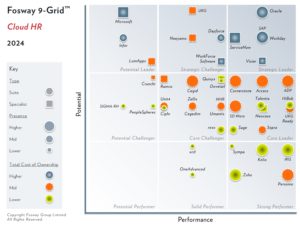
Publié en octobre 2024, le Fosway 9-GridTM pour le Cloud RH looks at the ever-changing, ever-competitive landscape of core HR systems.
Here Fosway analysts pull out a couple of key market trends that HR leaders should be keeping an eye on.
Skills-based operating models are unlocking agility
Organisations transitioning to a skills-based operating model are redefining how work is organised. As companies seek more agile, adaptive ways of managing talent, their focus has shifted away from traditional job titles and roles to a more fluid, skills-based approach. This is driven by the need to address real talent shortages as well as the imperative for greater business agility.
A workforce that is deployed based on skills and capabilities, is easier to realign with real-time business needs. The frontrunners are seeing success by unlocking potential they may have otherwise overlooked, enabling more dynamic and engaged workforces. It also allows employees to contribute in ways that fit their unique skills, whilst giving organisations the flexibility to reallocate talent quickly and respond to market changes with greater speed.
However, scaling this model is challenging, especially across the EMEA region where different countries enforce different restrictions as well as differing cultural views on skills and skills validation. Despite heavy investment, the HCM suites often still require specialist support to both understand as well as unlock the true value of skills. Many organisations are only scratching the surface, relying heavily on technology to map internal skills and drive workforce mobility, but lacking the internal frameworks and mindsets to fully operationalise this shift.
The needs of frontline workers shape advances in workforce-centric HCM
As companies in retail, logistics, hospitality, healthcare, and manufacturing struggle to attract and retain talent in Europe’s tight labour markets, the needs of frontline workers continue to drive HR priorities.
Whilst workforce-centric HCM has always prioritised labour flexibility and operational efficiency, there is now strong focus on improving the employee experience too. In the UK, earned wage access has become a key tool for financial wellbeing, with vendors now increasingly offering this solution natively or via specialists. Better employee listening and communication empowers workers, and work schedules are increasingly being aligned with employees’ preferred availability to create more adaptable, motivated teams.
Early adopters of these approaches are already seeing measurable reductions in employee turnover, as well as recruitment costs. There are still challenges though in scaling these approaches across EMEA. Earned wage access is limited to certain countries only due to regulatory barriers and different labour market dynamics.
This is an excerpt from the 2024 Fosway 9-Grid for Cloud HR. Obtenez un aperçu complet et découvrez les dernières tendances du marché et des solutions en lisant l'intégralité du rapport ici.
Que devriez-vous faire ensuite ?
- How will AI affect changes in workforce-centric HCM? Participez au projet stratégique de Fosway pour 2025 : ‘ L'IA dans les RH ’.
- What are your workforce challenges as an HR leader? Parcourir les dernières recherches sur les réalités des ressources humaines.
Autres lectures recommandées
- Other Fosway research related to Workforce-centric HR or Workforce Management
- Repenser le HCM : l'écosystème RH en nuage paper which discusses different models of HCM including Workforce-centric HCM
- Le Fosway 9-Grid 2024TM for Talent & People Success – full report which looks at trends in talent including how these might impact workforce-heavy organisations.
Pour les entreprises à la recherche d'informations plus approfondies sur ce sujet et d'autres thèmes similaires, veuillez considérer rejoindre notre réseau de recherche Fosway pour avoir accès aux tables rondes d'entreprise, à un temps d'analyste individuel en privé, à des rapports d'analyse comparative et à d'autres services d'analyste ou à un support de projet. Cliquez ici pour en savoir plus.
veuillez également visite le Centre de connaissances Fosway.
Consultez d'autres recherches et aperçus pertinents de Fosway, y compris des filtres par catégorie de segment, sujets clés, type de contenu et informations spécifiques aux fournisseurs.
 Français
  English (UK)
  Deutsch