


AI coaching is gaining popularity
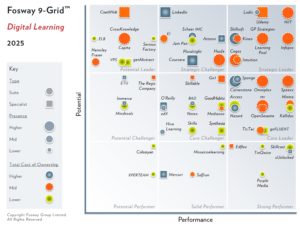
Veröffentlicht im März 2025, die Fosway 9-Grid™ für digitales Lernen looks at the market for Suites and Specialist content providers in the digital learning space. Here, Fosway analysts look at the impact of AI on the coaching industry, something traditionally very human-first.
Much is changing in the coaching world as AI reaches further into the industry. The use of conversational AI tools, trained on coaching models and techniques to offer feedback, reflection and guidance is one area of development. These tools are now present in specific programmes and solutions as well as standalone services for employees. The use of AI coaches is also taking a greater role as a substitute for human coaching too, priced for widespread adoption and aiming to fulfil the promise of democratising coaching for all workers.
Improvements in synthetic voice technologies and reduced latency for spoken interactions are improving these tools rapidly. Managing the data gathered from AI coaching sessions needs great care – differing fundamentally from the contractual and ethical guarantees expected of a human coach. Personal human coach/coachee relationships are, of course, highly valued and remain popular, particularly for senior leaders. But it is likely that human-led coaching will take a place at the premium end of a new spectrum of coaching solutions, with AI widening the spectrum significantly.
Skills demand signals strategic relevance for L&D
Whilst AI continues to draw in much of the oxygen of discussion, the ‘skills imperative’ remains a prime driver for L&D teams in corporate settings. Hiring for skills is insufficient alone – there is generally not enough skilled talent available to hire! Upskilling, reskilling and new skills development are now strategic problems for L&D to solve. Skills also offers a platform of relevance to the business that many traditional L&D activities do not. In larger companies, skills is often the domain of the talent organisation, not L&D – a crucial stakeholder for learning leaders. Skills intelligence, enabled by AI, provides the direction for skills development at scale. Mapping unique organisational skill frameworks is a must-have capability to help employees navigate their own route and progress from a personally relevant start point.
If it ever were enough, learning content alone falls short. Added to the personal context of role and tasks is the need to practise the application of skills in that context. Provision of safe environments to rehearse skills is important and becoming more realistic at scale as conversational AI tools offer guidance and help learners reflect whilst developing interpersonal skills. Sandboxes and labs are an increasingly common feature of technical skill solutions too. The latter now set the standard for evidence for technical skills validation whilst Gen AI experiences show a similar potential for broader business and personal skills.
Demand for AI skills is endless
The ability to understand, plan for, develop, manage and maintain AI solutions is a pressing strategic challenge for all businesses. AI skills are highly valued and recruiting for them, let alone retaining them, is a headache. Add the rapid pace of AI innovation, with fresh skills demands seemingly arriving every month, and AI skills is a high-demand category for all L&D teams as well as digital learning solutions.
Core AI technology skills, AI strategy skills, AI implementation, risks, safety and security are all rich new skills seams to explore. And as with many core business skills categories, the most useful learning solutions require a range of exploratory experiences, hands-on practice, skills validation, feedback and moments of reflection too. In this case, learning experiences built on strong and evident AI expertise and experience have a clear advantage, favouring providers with a strong technology heritage.
Dies ist ein Auszug aus der Fosway 9-Grid™ für digitales Lernen. Gewinnen Sie tiefgreifende Einblicke und entdecken Sie die neuesten Markt- und Lösungsentwicklungen, indem Sie den vollständigen Bericht lesen. hier.
Was sollten Sie als Nächstes tun?
- How will AI further affect coaching and L&D more generally? Take part in Fosways strategisches KI-Projekt für 2025: ‘KI im Lernen’.
- Nicht mehr lange, um Teil von Digital Learning Realities 2025 zu sein – äußern Sie Ihre Meinung, bevor die Umfrage endet. Teilen Sie Ihre Erfahrungen im diesjährigen Forschungszyklus und erhalten Sie einen ersten Einblick in die Ergebnisse.
Weitere empfohlene Lektüre
- Durchsuchen Sie alles rund um KI im Fosway Group Knowledge Centre. Erfahren Sie hier mehr.
- Das 2025 Fosway 9-GridTM für Lernsysteme – Vollständiger Bericht. Neu veröffentlicht: der neueste Überblick über Markt- und Lösungstrends bei Lernplattformen – erhalten Sie noch heute die vollständige Analyse.
- Transitioning from talent management to people success. Skills and coaching play their part in Talent & People Success.
Für Unternehmen, die tiefere Einblicke in diese und ähnliche Themen suchen, ziehen Sie bitte in Betracht mit unserem Fosway-Forschungsnetzwerk beitreten um Zugang zu Unternehmens-Roundtables, privater 1-zu-1-Analystenzeit, Benchmark-Berichten und anderen Analystendiensten oder Projektunterstützung zu erhalten. Klicken Sie hier, um mehr zu erfahren.
Bitte auch besuchen Sie Fosway Wissenszentrum um weitere relevante Fosway-Forschungsergebnisse und Einblicke zu prüfen, einschließlich Filtern nach Segmentkategorie, Schlüsselthemen, Inhaltstyp und anbieterspezifischen Informationen.
 Deutsch
  English (UK)
  Français